Bird Nest in Your Dryer Vent? What to Do, What's Legal, and How to Keep Them Out on Long Island (2026)
By the Bobby Bugs Team, Licensed New York State Pest Control Applicators, Serving Nassau, Suffolk, Queens & The Bronx
10 min read
Key takeaways
- A clogged dryer vent is a fire risk, not just an annoyance. Federal fire data attributes roughly 2,900 dryer fires a year to residential buildings, and failure to clean is the single biggest factor, at about a third of them.
- Starlings, house sparrows, and pigeons are not protected by the Migratory Bird Treaty Act or New York's Environmental Conservation Law. Those nests can be removed any day of the year, eggs included.
- Native songbirds (robins, wrens, chickadees, and others) are protected while eggs or chicks are in the nest. That nest waits, and the wait is usually two to five weeks.
- The same bird comes back to the same vent every spring unless the opening is physically sealed. Removal without a metal cap is a rental, not a repair.
- Bobby Bugs removes the nest, sanitizes the duct, installs the cap, and puts a 6-month written guarantee on the treated opening.
What should I do if there is a bird nest in my dryer vent?
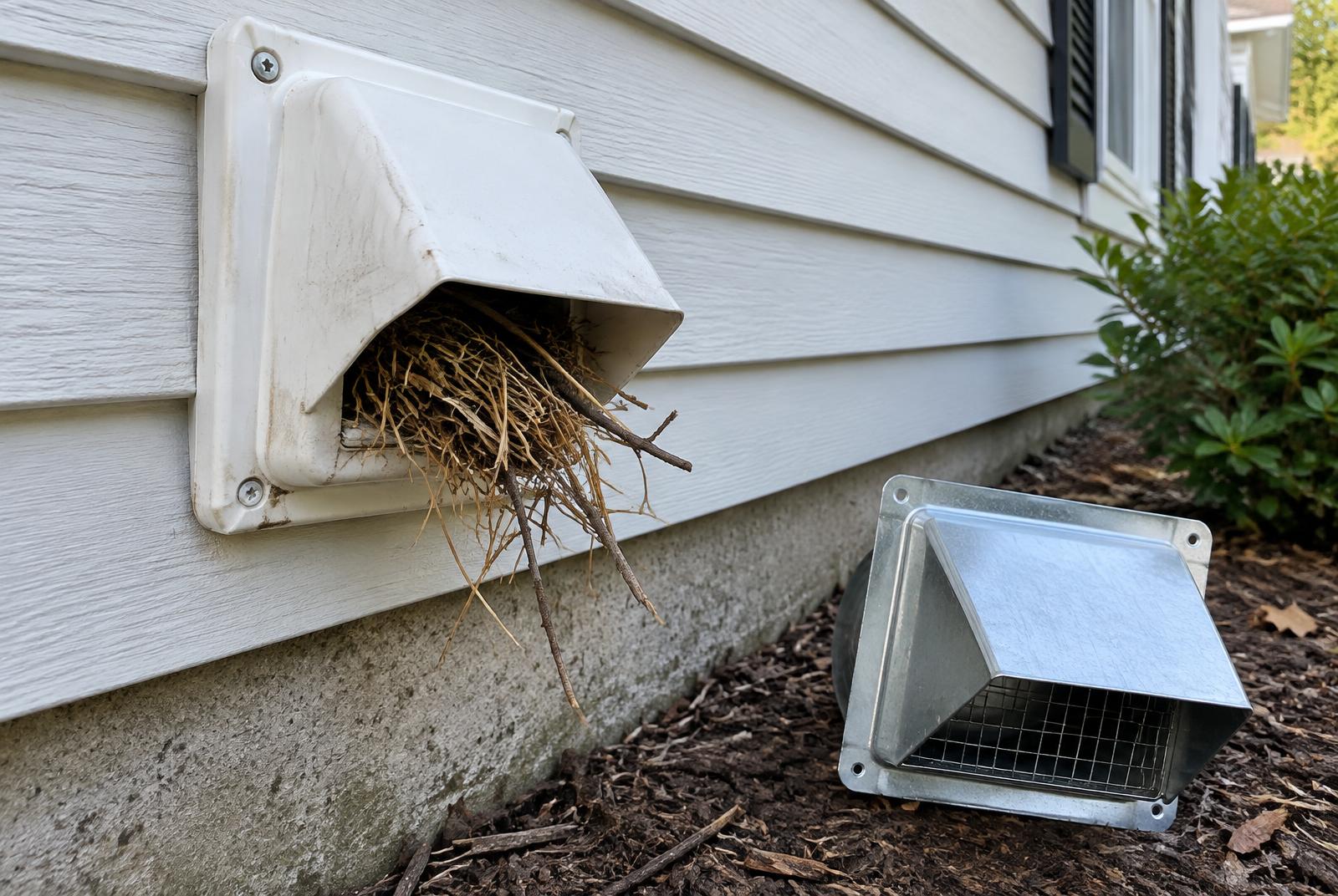
Stop using the dryer, unplug it or shut the breaker, and check the exterior vent hood from outside. If you see twigs, straw, or grass poking out of the flap, or the flap is stuck open, the duct is blocked. Do not run another load until the nest is out, because lint and heat behind a plugged duct is exactly how dryer fires start.
In thirty five plus years of doing this on Long Island, the call usually starts one of two ways. Either someone hears scratching and chirping in the laundry room wall, or their towels are coming out damp after a full cycle and they assume the dryer is dying. Nine times out of ten it is the vent, and the dryer is fine.
What you should not do is shove a broom handle in and push the material deeper, or spray anything into the duct. Pushing it in packs the nest into the elbow behind the wall where it is much harder to reach. The right sequence is to identify the bird, confirm whether eggs or chicks are present, pull the material out toward the exterior, clean the full run, and cap it. If you are not sure what species you are looking at, the next section tells you how to tell, and the law depends on it.
Is it illegal to remove a bird nest from a dryer vent in New York?
It depends on the bird, not the vent. Under the federal Migratory Bird Treaty Act it is illegal to remove or destroy an active nest of a protected native bird, and that includes an in-use nest on the outside of a house. Starlings, house sparrows, and feral pigeons are not covered by that act, and New York's Environmental Conservation Law lists starlings and pigeons as unprotected as well, so their nests can be removed at any time.
Here is the hard truth people do not like hearing. If a robin or a wren has eggs in that vent, you wait. Federal rules allow removal of inactive nests without a permit, meaning no eggs and no young, but removing an in-use nest on a building exterior is not covered, and permits for that are rarely issued just because the location is inconvenient. The good news is that native songbirds rarely choose a dryer vent. It is hot, it smells like fabric softener, and it vibrates. The birds that love that spot are the two non-native cavity nesters, starlings and house sparrows, and for those the answer is yes, take it out today.
We are not lawyers and this is not legal advice. It is what thirty five years of pulling nests out of Nassau and Suffolk vents has taught us about which nests we can touch and which ones we schedule for after the chicks leave. When there is any doubt about the species, we photograph the nest and the adult before anything comes out.
What kind of bird nests in dryer vents on Long Island?
On Long Island it is almost always a European starling or a house sparrow. Both are non-native cavity nesters that treat a 4 inch dryer duct like a hollow tree, both start nesting in early spring, and both will raise two or sometimes three broods in the same vent between March and August if nobody stops them.
A starling is a chunky, dark, glossy bird with a yellow bill in spring and a short tail, and its nest is a messy pile of grass and straw, often with trash or feathers mixed in. A house sparrow is small and brown, the male with a black bib, and its nest is a loose dome of dried grass stuffed into the duct. If you see a bird with a rust orange breast (robin) or a tiny brown bird with an upturned tail (wren), that is a native species, and the rules in the section above apply.
Why do birds keep nesting in my dryer vent?
Because it is warm, dry, sheltered from cats and hawks, and usually unscreened. A dryer vent pushes out warm, humid air several times a week, which is exactly the microclimate a cavity nester is looking for in March when the trees are still bare. Once a starling or sparrow has raised a brood there, it comes back to the same opening every year, and so do its offspring.
The flap on a standard plastic vent hood is not a barrier. A starling can pry it open in seconds and hold it with its body while it goes in. On most of the houses we service in Nassau and Suffolk the hood is the original builder-grade plastic, the flap is warped or missing, and there is nothing behind it. That is not a bird problem. That is an open hole in your house at bird height.
Can a bird nest in a dryer vent cause a fire?
Yes. A nest blocks airflow, lint builds up behind it, and the dryer runs hotter and longer trying to push moist air through a plugged duct. The U.S. Fire Administration estimates around 2,900 clothes dryer fires in residential buildings each year, and failure to clean the dryer and its vent is the leading factor, involved in roughly 34 percent of them.
A nest is not just a clog. It is dry grass, straw, and feathers packed against a stream of hot air, sitting inside a duct that also holds lint. We have opened vents on Long Island where the nest material was scorched brown on the dryer side. That house got lucky.
The warning signs are the ones people ignore for weeks: clothes taking two cycles to dry, the top of the dryer hot to the touch, a burning smell in the laundry room, or the exterior flap that never opens when the dryer is running. Any one of those means stop and look at the vent before you run another load.
How does Bobby Bugs remove a bird nest from a dryer vent?
Bobby Bugs removes a bird nest from a dryer vent by confirming the species and activity first, pulling nest material out from the exterior, clearing the full duct run, sanitizing the opening, installing a bird-resistant cap, and backing the treated opening with a written 6-month guarantee.
Here is how the dryer vent bird nest service works.
- Free phone triage. We ask what the vent looks like, how high it is, whether you have seen the bird, and whether there is chirping. Most jobs are quoted over the phone from that call.
- Species and activity check on site. We confirm whether it is a starling, a house sparrow, or a protected native bird, and whether there are eggs or chicks. Unprotected species and inactive nests come out the same visit. A protected active nest gets scheduled for after the young leave, typically two to five weeks.
- Removal from the exterior. We pull the nest material and debris out toward the outside so nothing gets packed deeper into the duct or the elbow behind the wall.
- Full duct clearing. We clear the run from the hood back to the dryer connection so the lint that built up behind the nest comes out with it.
- Sanitizing the opening. Bird nests carry mites and droppings. We treat the hood and the first section of duct so nothing crawls into the laundry room after the birds are gone.
- Metal vent cap or screen. We replace the plastic hood with a metal cap that has a louvered, bird-resistant design that still lets lint pass, or screen it with the correct mesh. This is the step that ends the problem.
- Written 6-month guarantee. If a bird gets back into that treated opening within 6 months, we come back at no charge.
How do I keep birds out of my dryer vent for good?
Put a metal, louvered vent cap on the opening and keep the duct clean. A plastic flap is not a barrier and a warped plastic flap is an invitation. The cap has to be designed for dryer exhaust so it sheds lint instead of trapping it, because a fine mesh screen over a dryer vent will clog with lint in a season and create the exact fire risk you were trying to avoid.
Beyond the dryer vent itself, walk the house in late February before nesting starts and look at every other opening at the same height: bathroom exhaust vents, kitchen range hood vents, soffit returns, the chimney, and any gap where a cable or pipe enters the siding. Starlings and sparrows go down the list. Cap the dryer vent alone and next spring they are in the bathroom fan.
Clean the dryer duct at least once a year, twice if it is a long run with elbows. A clean duct means more airflow, which makes the vent less attractive to a nesting bird and, more importantly, keeps the dryer out of the fire statistics. Trimming branches that overhang the vent side of the house and cleaning gutters every spring and fall takes away the staging areas birds use before they commit to a vent.
How much does bird nest removal cost on Long Island?
Bird nest removal cost on Long Island depends on the species, how high the vent is, whether the nest is active, how far into the duct the material has been packed, and whether the opening needs a new cap. Bobby Bugs quotes every job in writing, for free, before any work begins, the invoice matches the quote, and the treated opening carries a 6-month written guarantee.
Be careful with two kinds of pricing. The first is the handyman who pulls the visible material out of the hood for a low flat fee and leaves the plastic flap in place. That job is back in a month. The second is the open-ended dryer vent cleaning service that charges per visit and does not do exclusion at all. Ask any quote one question: does the price include a bird-resistant cap on the opening? If the answer is no, you are paying for a removal, not a fix. See our bird nest removal service for the full scope. If the noise in the wall turns out to be scratching rather than chirping, you may be dealing with squirrels or raccoons in the attic instead, which is a different job with different rules.
Frequently Asked Questions
Is it illegal to remove a bird nest from a dryer vent?
Only if the nest belongs to a protected native bird and has eggs or chicks in it. Starlings, house sparrows, and feral pigeons are not protected under the federal Migratory Bird Treaty Act or New York's Environmental Conservation Law, and those are the birds in almost every Long Island dryer vent. Their nests can be removed at any time.
How do I know if the bird nest in my vent is active?
Watch the vent for 15 to 20 minutes at dawn or dusk. Adults flying in and out, chirping from inside the wall when the dryer is off, or fresh droppings on the siding below the hood all mean an active nest. No traffic for two or three days in season usually means the young have fledged or the nest was abandoned.
How long do I have to wait if the nest is protected?
Usually two to five weeks. Most small songbirds incubate for about two weeks and the chicks leave the nest roughly two to three weeks after hatching. Once the young are gone the nest is inactive and can be removed and the vent capped before the pair tries a second brood.
Can I run my dryer with a bird nest in the vent?
No. A blocked vent traps heat and lint inside the duct, and failure to clean is the leading factor in the roughly 2,900 residential dryer fires the U.S. Fire Administration counts each year. Stop using the dryer until the duct is cleared.
What does a bird nest in a dryer vent look like from outside?
Straw, grass, or twigs sticking out of the vent hood, a flap that is stuck open or missing, droppings on the siding below the opening, and lint that is no longer blowing out when the dryer runs. Inside the house you may hear scratching or chirping in the laundry room wall.
Do bird nests in vents carry mites or disease?
Yes. Starling and sparrow nests commonly carry bird mites, and the droppings can hold fungal spores and bacteria. When the birds leave, the mites look for a new host, which is why some homeowners notice tiny biting bugs in the laundry room a week after the nest goes quiet. Bobby Bugs sanitizes the opening as part of every removal.
Will the birds come back after the nest is removed?
Yes, unless the opening is physically capped. Starlings and house sparrows return to the same cavity every spring, and so do their offspring. Removal without a bird-resistant metal cap almost always means a repeat call the following March.
Hearing chirping in the laundry room wall, or towels coming out damp? Get the vent cleared and capped before the next load.
Nassau and Suffolk homeowners: we identify the bird, tell you plainly whether the nest can come out today or has to wait, clear the full duct, cap the opening, and put the price in writing before any work starts. Most vent jobs are quoted over the phone and done in one visit, with a 6-month written guarantee on the treated opening.
This article is general pest information for Long Island homeowners, not a diagnosis of your specific situation. Pest behavior varies by home, season, and species, and every job is quoted in writing before any work begins. Pesticide applications are performed by licensed New York State applicators in accordance with label requirements.