How Do You Get Rid of a Wasp Nest? The Safe Way for Long Island Homeowners, and the 4 Nests You Should Never Touch (2026)
By the Bobby Bugs Team, Licensed New York State Pest Control Applicators, Serving Nassau, Suffolk, Queens & The Bronx
10 min read
Key takeaways
- The nest type decides the method. Paper wasps build small open umbrella nests you can see into. Bald-faced hornets build closed gray paper footballs. Yellow jackets nest underground and inside walls. Each one is treated differently, and using the paper wasp method on a yellow jacket nest is how people end up in the emergency room.
- Dusk is the right time, not midday. At dusk the foragers are home, the colony is sluggish, and there are no wasps in the air behind you.
- Never plug, seal, caulk, or tape a nest entrance, and never spray a wall void nest from inside the house. A sealed colony chews a new exit, and on Long Island that exit is often into a bedroom.
- Spraying a nest and running is not a treatment. Stragglers rebuild next to a half-dead nest. The nest has to be fully treated and, once dead, removed or the site treated so it is not attractive again.
- Mid-August through early October is peak season on Long Island. Colonies are at their largest and most defensive, which is why the same nest that was a ten-minute job in June is a call-a-professional job in September.
- Wasps do not reuse an old nest, but they absolutely reuse a good location. If you had a nest under the same soffit two years running, the spot is the problem, not bad luck.
How do you get rid of a wasp nest?
You get rid of a wasp nest by treating the colony directly, at dusk, with a product matched to the nest type, then removing the dead nest or treating the site once activity has stopped. The three parts that matter are timing (dusk or dawn), distance (never closer than the product requires), and the entrance (always left open). Everything else, including the brand on the can, matters less than those three.
We have treated thousands of nests across Nassau and Suffolk, and the calls that end with someone getting stung a dozen times almost always trace back to one of three mistakes. They treated at noon when half the colony was out and came home to find a stranger standing at the door. They stood too close because the can said 20 feet and they did not trust it. Or they saw the entrance, thought "I will just plug that," and turned a ground nest into a nest in the family room.
The honest version of this article is that most people can handle a small paper wasp nest under a railing with a can from the hardware store and a little patience. The rest of it is about knowing which nest you actually have, because that is the part homeowners get wrong, and it is the part that decides whether this is a DIY job or a phone call.
Which wasp nest do you have? Paper wasps, bald-faced hornets, yellow jackets, or European hornets
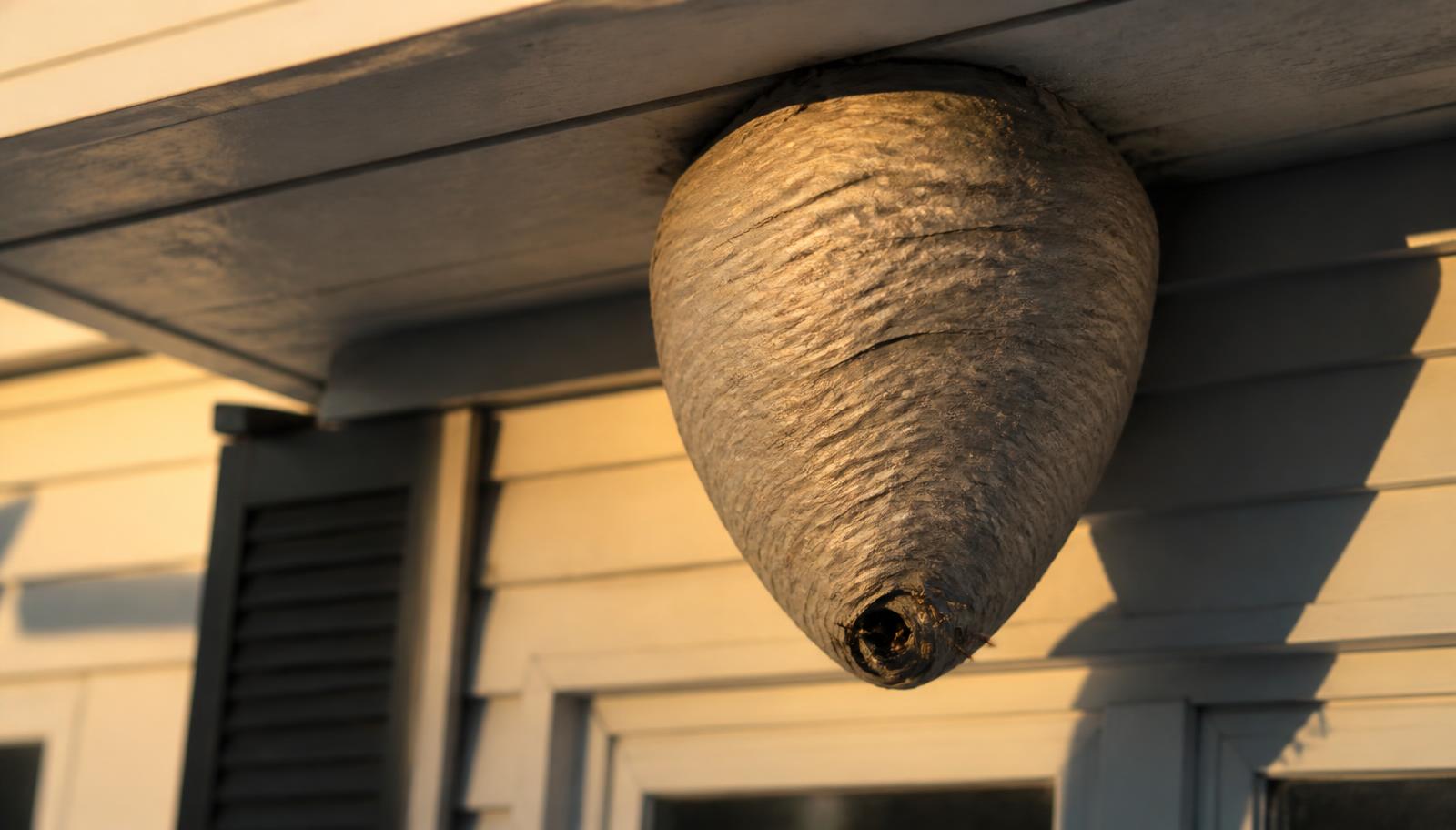
On Long Island there are four stinging colonies that build nests on or near homes, and you can tell them apart by the nest itself. An open, umbrella-shaped comb with visible cells under an eave, railing, or grill lid is paper wasps. A closed, gray, papery football hanging in a tree, shrub, or off the side of the house is bald-faced hornets. A hole in the lawn, mulch bed, or a gap in the siding with steady in-and-out traffic and no visible nest is yellow jackets. A large, reddish-brown wasp nesting in a hollow tree or wall void and flying around your porch light at night is the European hornet.
Paper wasps are the least aggressive of the four. They will defend the nest if you brush it, but they do not send out patrols, and a nest the size of your palm usually holds a few dozen wasps. Bald-faced hornets are technically a large yellow jacket, not a true hornet, and they are the most defensive nest builder on Long Island. A mature nest in September can hold several hundred workers, they attack in numbers, and they can squirt venom toward the eyes of anything that shakes the nest. Yellow jackets are the ones that ruin Labor Day. Ground nests can hold a few thousand workers by late summer, the colony is hidden so people mow over it or step on it, and they sting repeatedly. Wall void yellow jacket nests are the single most common wasp job we do inside a house, and they are the ones you hear before you see, a papery rustling behind the drywall in the evening. European hornets are big enough to startle anyone, but they are less aggressive than yellow jackets and mostly a problem when the nest is in a wall or a hollow tree next to the house, because they are active at night and are drawn to lit windows.
If what you are looking at is a fuzzy, brown and gold cluster on a branch or a steady stream of bees going into a wall with a faint honey smell, that is honey bees, not wasps. We do not treat honey bees. Call a Long Island beekeeper who does live removals. Treating a honey bee colony inside a wall leaves pounds of honey with no bees to cool it, and it comes through the ceiling.
When is the best time to spray a wasp nest?
The best time to treat a wasp nest is at dusk, roughly 15 to 30 minutes after sunset, or in the first light of dawn before the day warms up. At those hours nearly the entire colony is inside the nest, the wasps are cool and slow, and there are no foragers in the air behind you. Treating at midday is the most common mistake we see, because up to half the colony is out and comes home to a disturbed nest and a person standing next to it.
Two practical notes for Long Island. First, use a flashlight with a red filter or a piece of red cellophane over the lens, since wasps see poorly in red light and will not fly to the beam. Never hold a white light on the nest while you spray, because the workers will fly at the light and the light is in your hand. Second, season matters as much as time of day. A paper wasp nest in May has one queen and a handful of workers and takes seconds. The same nest in late August is ten times the size. If you have been watching a nest grow all summer and it is now the size of a softball or bigger, the DIY window has closed.
Should you remove a wasp nest yourself?
You can reasonably remove a small, exposed paper wasp nest yourself if it is within reach without a ladder, it is smaller than your fist, no one in the household has a sting allergy, and you can treat it at dusk from the full distance the product allows. You should not attempt a bald-faced hornet nest, a yellow jacket ground nest, any nest inside a wall, soffit, or attic, or any nest that requires standing on a ladder, because those are the four situations that produce the multi-sting incidents that send Long Islanders to the emergency room every August and September.
The ladder rule is not about the wasps. It is about what happens when a wasp stings you on the neck while you are eight feet up holding a spray can. People fall. That is the injury we hear about most, not the stings. And the sting allergy rule is absolute. If anyone in the house has ever had swelling beyond the sting site, trouble breathing, or been told to carry an epinephrine injector, nobody in that house should be treating nests, full stop. Have it done professionally and keep the injector in the yard until the site is confirmed dead.
The last thing to understand is that a professional job is not the spray can with a better label. For a wall void or ground nest we use an insecticide dust applied directly into the entrance, which the workers track through the entire nest over the next day. That product and that technique are not what you find on the shelf at the hardware store. For a bald-faced hornet nest we treat the entrance hole directly and then remove the nest once it is dead, and we come back if there is any activity at the site within the guarantee period. That is why a wasp job is a flat, one-visit price with a 6-month written guarantee, not a monthly service.
How to get rid of a small paper wasp nest in 3 steps
If your nest passes every test in the section above (paper wasps, exposed, small, reachable from the ground, no allergies in the house), here is the sequence that works.
- Wait for dusk and dress for it. Long sleeves, long pants, closed shoes, and a hat. Cover your neck. Plan your exit before you start: know which door you are walking through and make sure it is unlocked and unobstructed. Keep kids and pets inside.
- Treat from the full labeled distance with an aerosol wasp and hornet jet spray, aimed at the nest and the wasps on it, until the nest is saturated. Most jet products reach 15 to 20 feet. Do not walk toward the nest to get a better angle, and do not stand under it. Once you have sprayed, walk away calmly along your planned exit. Do not swat, do not run, do not linger to watch.
- Check the next evening, not the next morning. If there is no activity at the nest at dusk the following day, knock the nest down with a long pole or scraper, bag it, and treat the surface it was attached to so returning stragglers do not rebuild there. If there is still activity, repeat step 2 once. If there is activity after a second treatment, the nest is bigger than it looks or it is not paper wasps, and it is time to call.
Why should you never seal a wasp nest entrance or spray a wall nest from inside?
You should never seal, plug, caulk, or tape the entrance to a wasp nest because a trapped colony does not die, it digs. Yellow jackets and hornets chew through drywall, insulation, and plaster to find a new exit, and when the nest is in a wall, the new exit is inside your house. Spraying an aerosol into a wall void from the inside is just as dangerous, because the wasps retreat away from the spray, deeper into the wall and toward the interior rooms.
The right approach to a wall void nest is the opposite of the instinct. The entrance stays open. A licensed applicator dusts the entrance from outside so the workers carry the treatment into the nest, and the colony dies inside the wall over one to two days. Once it is dead and there has been no activity for a week or more, then the gap gets sealed, so next year's queen cannot use the same hole. Seal too early and you have a wall full of angry insects looking for a way out. Seal never and you have a new nest in the same void in a year or two. The order is treat, wait, confirm, then seal.
Attic nests follow the same logic. Do not go up there at night with a can. The nest is usually against the roof deck near a soffit vent, the attic is hot, the footing is bad, and there is nowhere to go. That one is always a professional job.
Two things people skip on any nest. Read the label and follow it, because these are pesticides and a New York homeowner is only allowed to use them on their own property exactly as labeled. And never use gasoline, kerosene, a torch, or a hose on a nest. We get called after all three every summer, and the hose is the worst of them, because it does nothing to the colony and everything to their mood.
Will wasps come back to the same nest?
No. Wasps, hornets, and yellow jackets on Long Island do not reuse an old nest. The colony dies at the first hard frost, usually in November here, and only the newly mated queens survive the winter, tucked under bark, in a woodpile, or in your attic. In spring each queen starts a brand new nest from scratch. What they do come back to is the location, because the same shaded, sheltered, dry spot that attracted this year's queen will attract next year's.
This is why we treat the surface after a nest is removed and why we tell homeowners to think about the spot rather than the nest. A nest under the same soffit two years in a row means that soffit has a gap, a shadow, or an overhang that reads as prime real estate to a queen in April. It also means a dead nest left hanging over the winter is not protecting you from anything. It is fine to knock it down once it is dead, and after a hard frost you can remove an old exposed nest with no treatment at all.
How do you keep wasps and hornets from coming back?
The most effective prevention on Long Island is a spring walk-around, because a golf ball sized April nest with one queen on it takes seconds to remove and a September nest does not.
In April and May, queens are scouting and starting nests the size of a golf ball. A nest that size, with one queen on it, can be knocked down with a broom handle or treated in seconds, and every one you remove in May is a softball-sized colony you do not have in September. Walk the eaves, the deck railing underside, the grill, the mailbox, the shed, and the kids' playset once a week from late April through June.
Seal gaps in siding, soffit, and around utility penetrations before spring so yellow jacket queens cannot get into the walls. Keep garbage cans lidded and rinse recycling, since late-summer yellow jackets are protein and sugar foragers and a sticky recycling bin is a beacon. Fix the hole in the lawn where a ground nest was last year, because the same soft soil invites the next queen. For homes that get a nest in the same problem area every year, we offer a pre-treatment of that area in June or July that discourages nest building before colonies get large, as part of our wasp and hornet removal work.
Two lookalikes worth naming before you treat anything. The big solitary wasps digging in sandy soil in July are cicada killer wasps, a different animal with a different treatment, and they do not defend a colony. The big black bees hovering around your fascia and deck rail in spring are carpenter bees, not wasps, and they are treated differently because the damage is the tunnel in the wood, not the sting.
Frequently Asked Questions
How do you get rid of a wasp nest?
Treat the nest directly at dusk, when the whole colony is inside, from the full distance your product allows, using an aerosol jet for an exposed paper wasp nest or an insecticide dust at the entrance for a ground or wall nest. Leave the entrance open, check the next evening, and remove the dead nest once activity has stopped. Bald-faced hornet nests, yellow jacket ground nests, and any nest inside a wall or attic should be handled by a licensed applicator.
When is the best time to spray a wasp nest?
At dusk, about 15 to 30 minutes after sunset, or at first light. The colony is inside and sluggish, and no foragers are in the air. Treating at midday, when many workers are out, is the most common cause of DIY stings.
Should I remove a wasp nest myself?
Only if it is a small, exposed paper wasp nest you can reach from the ground, nobody in your household has a sting allergy, and you can treat it at dusk from the labeled distance. Nests inside walls, ground nests, bald-faced hornet nests, and anything that needs a ladder are professional jobs.
What is the difference between wasps, hornets, and yellow jackets?
On Long Island, paper wasps build small open umbrella-shaped nests under eaves and railings. Bald-faced hornets build closed gray football-shaped paper nests in trees and on structures. Yellow jackets nest underground and inside wall voids with no visible nest, just traffic in and out of a hole. All three sting repeatedly, and all three are treated at the same flat rate.
Will wasps come back to the same nest?
No. The colony dies at the first hard frost and the nest is never reused. Mated queens overwinter and build a new nest each spring, and they favor the same sheltered locations, so a spot that had a nest this year is likely to get one next year unless it is sealed or treated.
How long does it take to get rid of a wasp nest?
When the nest is treated directly with the right product, activity at the nest usually stops within about 15 minutes. Foragers that were away return over the next day or two and die off inside 24 to 48 hours. Removal of the dead nest and treatment of the site is the same visit for exposed nests.
What should I do if I get stung multiple times?
Get away from the nest first, then wash the stings and apply cold. If you have any swelling away from the sting sites, trouble breathing, dizziness, or a history of a severe reaction, use an epinephrine injector if you have one and call 911. Multiple stings from a yellow jacket or hornet nest can be a medical emergency even for someone with no known allergy.
When are wasps most aggressive on Long Island?
From mid-August through early October, when colonies are at their largest and are switching from protein to sugar foraging. Yellow jackets are especially defensive around Labor Day weekend, which is why late-summer nests should be treated promptly rather than watched.
Found a nest you should not touch? Get it treated tonight, with a written price first.
Nassau and Suffolk homeowners: we identify the nest over the phone, quote it in writing before any work begins, treat it directly the same or next day for most calls, and remove it once it is dead. Every wasp, hornet, and yellow jacket job carries a 6-month written guarantee against a new nest in the same spot. Mon to Sat, 7am to 7pm.
This article is general pest information for Long Island homeowners, not a diagnosis of your specific situation. Pest behavior varies by home, season, and species, and every job is quoted in writing before any work begins. Pesticide applications are performed by licensed New York State applicators in accordance with label requirements.