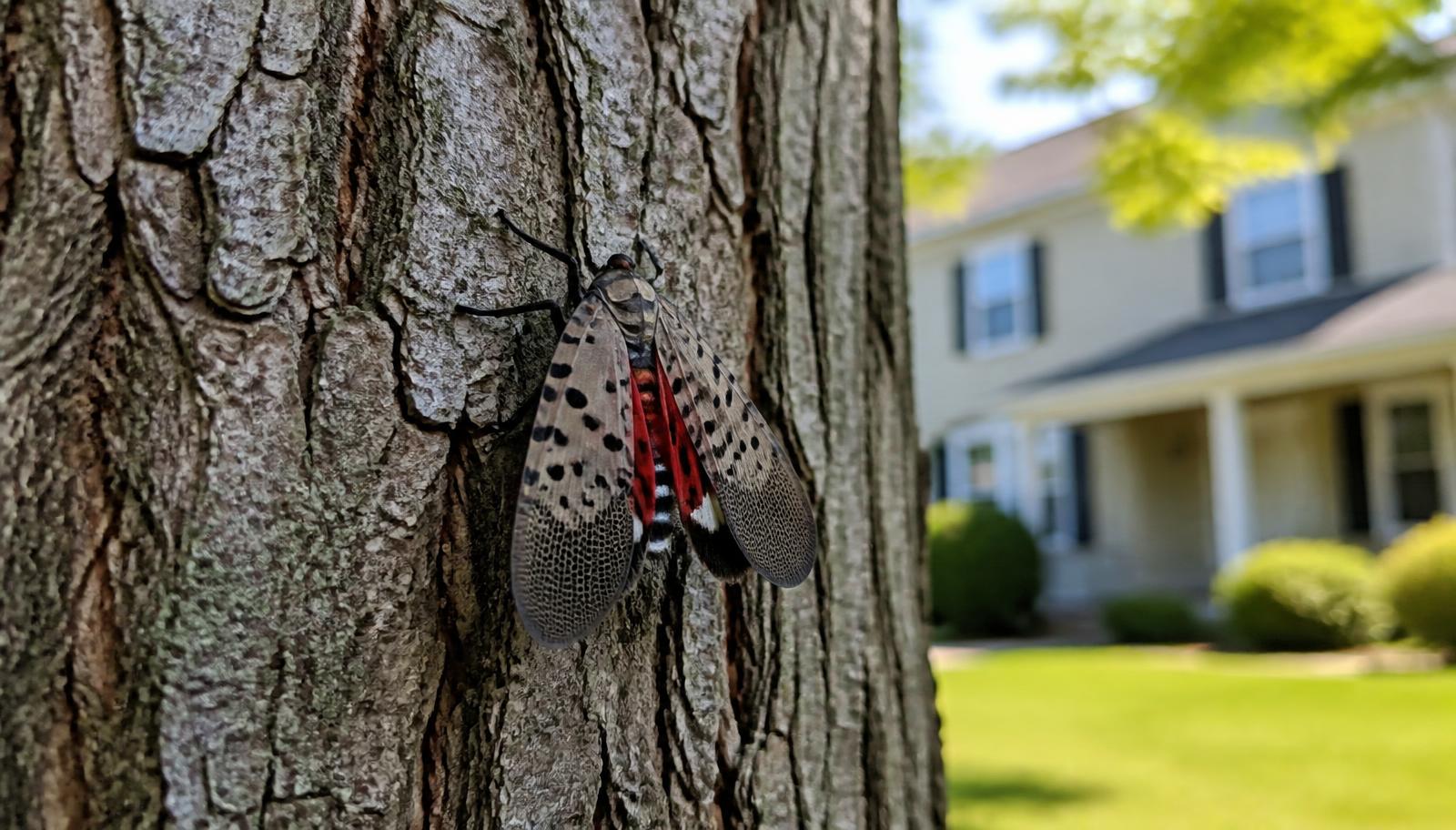
How to Get Rid of Spotted Lanternflies on Long Island: What Actually Works, What Does Not, and When to Call a Pro (2026)
By the Bobby Bugs Team, Licensed New York State Pest Control Applicators, Serving Nassau, Suffolk, Queens & The Bronx
9 min read
Key takeaways
- Spotted lanternflies do not bite, sting, or eat wood. The damage is to trees, vines, and outdoor surfaces, not to people or the structure of your house.
- They feed on sap and excrete a sticky liquid called honeydew that coats decks, siding, patio furniture, and cars, then grows black sooty mold on top.
- Squashing individual bugs feels productive but does not control a population. Each egg mass you destroy removes 30 to 50 lanternflies from next season.
- DIY sprays like dish soap and vinegar kill on contact only, and homemade mixes strong enough to work can burn the plants you are trying to protect.
- Late summer through fall is the deadline that matters on Long Island: adults are laying egg masses from September into November, and treating and scraping now shrinks next year.
- Professional treatment on Long Island is quoted in writing, for free, before any work begins, and carries a written seasonal guarantee.
How do you get rid of spotted lanternflies?
You get rid of spotted lanternflies by attacking all three stages at once: treat the trunks and foliage of the host trees where nymphs feed in late spring and early summer, treat the exterior surfaces where adults gather in late summer and fall, and scrape and destroy egg masses from fall through spring. Any one of these alone falls short. Killing adults without touching egg masses resets the problem next May, and scraping eggs without treating host trees leaves the reinfestation route open.
Here is the hard truth about the stomping advice you see everywhere. Yes, you should kill spotted lanternflies when you see them, and New York encourages exactly that. But a homeowner squashing a few dozen adults on the deck is not making a dent in a population where a single female lays up to 100 eggs before frost. Stomping is a supplement. It is not a plan.
The reason a plan matters on Long Island right now is momentum. These insects arrived in our area only a few years ago and populations have been climbing season over season across Nassau and Suffolk County. The properties that stay livable in August and September are the ones that treated host trees early and went after egg masses the previous fall, not the ones that bought a fly swatter in July.
Why are there so many spotted lanternflies on Long Island?
Spotted lanternflies are an invasive planthopper from Asia, first found in the United States in Pennsylvania in 2014 and confirmed in New York by 2020. They have no meaningful natural predators here, each female lays 30 to 50 eggs per mass, and they hitchhike on cars, trains, firewood, and outdoor furniture, which is exactly how they spread across Long Island. Once established in a neighborhood, populations build fast.
Their favorite host is tree of heaven, an invasive tree common along Long Island roadsides, railways, and fence lines, but they feed on dozens of plants including maples, willows, black walnut, fruit trees, and grapevines. If your block has tree of heaven or a stand of maples, that is why your patio has lanternflies and your friend's block two towns over does not, yet.
Do spotted lanternflies bite or sting?
No. Spotted lanternflies do not bite people, do not sting, and are not known to be harmful to humans or pets through contact. They are plant feeders with piercing, straw-like mouthparts built for tapping sap from trunks and stems, not skin. A lanternfly landing on you is a nuisance, not a danger.
The practical concern for pets is quantity, not venom. Dogs and cats sometimes eat them, and while they are not considered toxic, eating a lot of anything with that kind of chemistry can upset a pet's stomach. The real household harm is what these insects do to your trees and your outdoor living space, which is where the next section goes.
What damage do spotted lanternflies do to your trees and home?
Spotted lanternflies damage plants, not structures. They feed on sap in large groups, which stresses and weakens trees and vines, and they excrete a sugary liquid called honeydew that coats everything below the feeding site. The honeydew then grows sooty mold, a black fungal film that stains decks, siding, fences, patio furniture, play sets, and cars, and the sugar draws yellow jackets, wasps, and ants to your yard.
Healthy shade trees usually survive lanternfly feeding, but repeated heavy feeding weakens them, and grapevines and young or stressed trees can be killed outright. That is a real number for anyone on Long Island with ornamental plantings, fruit trees, or a vegetable garden they care about.
For the house itself, the good news is they do not eat wood, so unlike termites or carpenter ants they will never touch the framing. The bad news is that by late summer the honeydew and sooty mold can make a deck genuinely unusable, and adults massing on warm south-facing siding by the dozens is what finally makes most homeowners pick up the phone. Both problems are treatable, and both come back next year if egg masses are ignored.
What kills spotted lanternflies?
Contact insecticides kill spotted lanternflies quickly, and professional products applied to trunks, foliage, and exterior surfaces keep killing nymphs and adults that land there afterward, which is what actually knocks down a property's population. Household mixes like dish soap spray or vinegar can kill individual insects on direct contact but have no lasting effect and can burn grass and ornamental plants at the strength needed to work.
The internet is full of homemade lanternfly recipes, and we understand the appeal. The problem is not that soap fails to kill the bug in front of you. It is that the other several hundred on the property never touched the spray, the egg masses are untouched, and the plants you soaked may show damage before the lanternflies do. Home remedies also tend to get used with a heavy hand near vegetable gardens and ponds, where they do not belong.
Professional treatment is different because of placement and timing, not just product. A licensed applicator treats the specific host trees driving the infestation during the nymph stage, works the siding and deck lines where adults congregate in late summer, and uses materials labeled for those sites at the right rates. That combination is why a treated property gets quieter and stays quieter through the season while the neighbor's deck stays covered. Our spotted lanternfly treatment is built around that calendar.
How do you find and destroy spotted lanternfly egg masses?
Spotted lanternfly egg masses look like a smear of gray or tan putty, roughly an inch long, and each one holds 30 to 50 eggs. From September into November, females lay them on tree trunks, and on almost any flat outdoor surface: fence posts, firewood, outdoor furniture, grills, stone walls, trailers, and car wheel wells. To destroy one, scrape it into a bag or container with rubbing alcohol or hand sanitizer, or crush it completely until it pops. Just knocking a mass to the ground does not kill the eggs.
Egg mass hunting season on Long Island runs from fall until the first hatch in late spring, and it is the highest value work a homeowner can do themselves. Walk the property on a mild winter day and check trunks, the undersides of horizontal surfaces, and anything that sat outside since September. Every mass you scrape is 30 to 50 lanternflies that never show up in June. If you are moving firewood, furniture, or a trailer off the property, check it first so you are not the one spreading them to the next town.
When should you treat for spotted lanternflies on Long Island?
The best treatment window on Long Island matches the insect's calendar: eggs hatch in late spring, nymphs feed from roughly May through July, adults appear in late July and August, and egg laying runs September into November until frost kills the adults. Nymph-stage treatment in late spring stops the population before it matures, and late summer treatment protects your siding and deck during the adult swarm while cutting down the number of females that get to lay eggs.
If you are reading this in late August or September, you are not too late, you are at the second most important moment of the year. Adults are at peak numbers and every female stopped now is an egg mass that never happens. Fall treatment plus an egg mass sweep is how this season's misery gets converted into a smaller problem next year. Spotted lanternflies produce one generation per year, so the math compounds in your favor if you work it and against you if you wait.
What does professional spotted lanternfly treatment involve?
Professional spotted lanternfly treatment is a seasonal program, not a single spray. It combines host tree identification, nymph-stage treatment, adult-stage perimeter work, egg mass destruction, and return visits timed to your block's pressure.
Treatment cost depends on property size and the number of host trees, and it is quoted in writing before any work begins, starting with a free quote over the phone.
Here is exactly how our service runs:
- Property walk and host tree identification. We find what is driving your infestation, whether that is a tree of heaven at the fence line, a row of maples, or the neighbor's untreated stand, and we map where the activity concentrates.
- Nymph-stage treatment. In late spring and early summer we treat the trunks and foliage of host trees where nymphs are feeding, cutting the population down before it ever reaches the adult swarm stage.
- Adult-stage perimeter work. In late summer and fall we treat exterior surfaces where adults congregate, including siding lines and deck areas, which is what gives you your outdoor space back.
- Egg mass work. We scrape accessible egg masses and show you exactly what to look for and how to destroy the ones that appear on furniture, firewood, and fences through the winter.
- Return visits as needed. Lanternflies fly in from surrounding properties all season, so we schedule follow-ups based on how heavy your block's pressure is, backed by a written seasonal guarantee.
Frequently Asked Questions
Do spotted lanternflies bite or sting?
No. Spotted lanternflies do not bite or sting and are not known to harm people or pets through contact. They feed on plant sap with straw-like mouthparts that cannot pierce skin. The harm they do is to trees, grapevines, and outdoor surfaces coated by their sticky honeydew.
What is the fastest way to kill spotted lanternflies?
Direct contact kills them fastest: squashing them or hitting them with a contact insecticide. For an actual infestation, speed matters less than coverage, and treating the host trees and exterior surfaces they return to is what brings numbers down and keeps them down through the season.
Does dish soap or vinegar kill spotted lanternflies?
Only on direct contact, and neither has any lasting effect. Mixes strong enough to kill reliably can also burn grass, shrubs, and ornamental plants, and they do nothing about egg masses. Home remedies are fine for the occasional bug, not for a property with an established population.
What do spotted lanternfly egg masses look like?
A fresh egg mass looks like a one inch smear of gray or tan putty with a mud-like crackled coating, holding 30 to 50 eggs. You will find them from fall through spring on tree trunks, fences, firewood, outdoor furniture, stone, and vehicles. Scrape them into rubbing alcohol or crush them completely to destroy the eggs.
Do spotted lanternflies damage houses?
They do not eat wood or damage the structure of a house. The household damage is cosmetic and quality of life: honeydew and black sooty mold coating siding, decks, and patio furniture, plus the wasps and ants the sugary honeydew attracts. Trees, grapevines, and young plantings take the real biological damage.
When do spotted lanternflies die off on Long Island?
Adults die with the first hard frosts, typically by late fall on Long Island. Their egg masses survive the winter and hatch in late spring, which is why fall and winter egg mass destruction is the single best way to shrink next year's population.
How much does spotted lanternfly treatment cost on Long Island?
Spotted lanternfly cost on Long Island depends on property size, the number of host trees, apartment versus single family house, and how many return visits the season needs. National averages published online often do not match Long Island reality. Bobby Bugs quotes every job in writing, for free, before any work begins, and the price on the invoice matches the quote. The work carries a written seasonal guarantee.
Lanternflies taking over your deck and trees? Get a free quote today.
Nassau and Suffolk County homeowners: a licensed New York State applicator will identify your host trees, treat the nymph and adult stages at the right times, and show you how to wipe out egg masses before spring. Treatment is quoted in writing, for free, before any work begins, with a written seasonal guarantee.
This article is general pest information for Long Island homeowners, not a diagnosis of your specific situation. Pest behavior varies by home, season, and species, and every job is quoted in writing before any work begins. Pesticide applications are performed by licensed New York State applicators in accordance with label requirements.