Do Carpenter Bees Come Back Every Year? Yes, to the Same Holes. Why Plugging Them Fails and What Actually Works on Long Island (2026)
By the Bobby Bugs Team, Licensed New York State Pest Control Applicators, Serving Nassau, Suffolk, Queens & The Bronx
10 min read
Key takeaways
- Carpenter bees on Long Island are a spring and fall problem in the same wood. Spring is when you see them hovering and boring. Late summer and fall is when the new generation quietly moves back into the holes to overwinter.
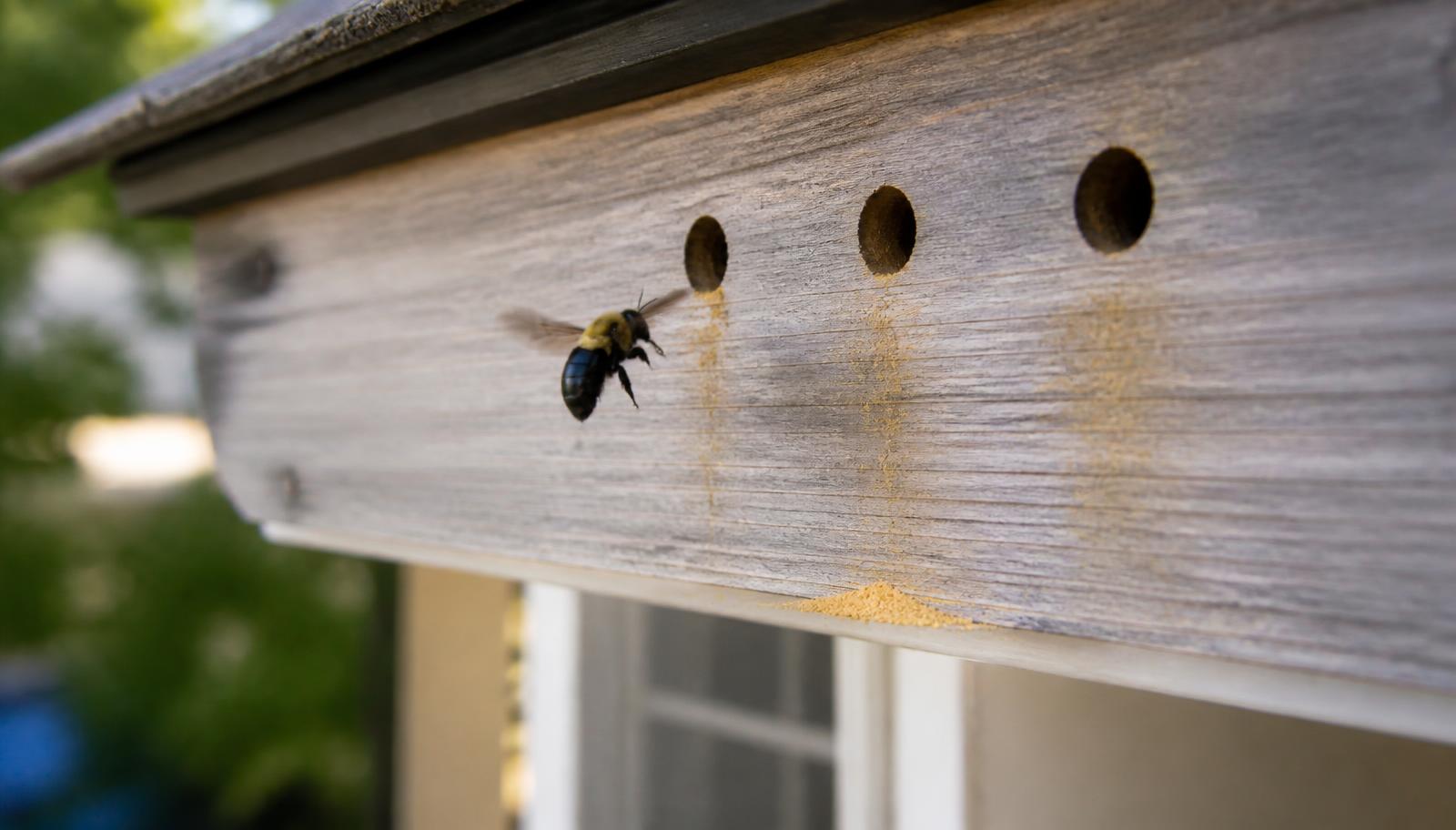
- Each half-inch hole is the front door to a tunnel that turns 90 degrees and runs along the grain, often 6 inches or more, and every year the females extend it. Damage is slow, but it compounds, and old galleries can run several feet.
- Woodpeckers do more damage than the bees. They hear larvae inside the wood and tear the fascia open to get them, which is how a few neat holes become a shredded board.
- Plugging holes without treating first traps live bees in the wood. They chew a new exit, sometimes into the house if the board backs onto living space. Treat, then wait, then plug, then paint. The order is the whole job.
- Bare and stained cedar, pine, and redwood are what they want. A properly painted surface is the single best long-term deterrent, and it is why the painted trim on the front of the house is fine while the stained pergola in back is full of holes.
- The males that hover in your face in April cannot sting. The females can, but almost never do unless handled. This is a wood problem, not a safety problem, which is exactly why people ignore it for years.
Do carpenter bees come back every year?
Yes. Carpenter bees return to the same wood, and usually the same holes, every year. The bees you see in April are not new arrivals from somewhere else; they are last year's offspring, emerging from the tunnels they overwintered in. Once out, the females mate and then reoccupy and enlarge the existing galleries, because reopening an old tunnel takes far less work than boring a new one. A carpenter bee problem that is not treated does not stay the same size. It grows every season.
This is the part homeowners on Long Island misunderstand most. We get called in May by someone who says the bees "showed up again," and when we look at the fascia, there are holes from three or four different seasons, some plugged with wood filler, some with a fresh hole bored a half inch from the plug. The bees never left. They were inside the board the whole winter, and they have been extending the same tunnel system since the first female picked that board years ago.
The good news is that the same habit that makes them persistent makes them treatable. Because they use the same holes, we know exactly where the galleries are, and a treatment placed into those holes reaches the bees, the larvae, and the new adults that will try to move back in this fall. Get the sequence right once and the cycle in that wood is over. Get it wrong, meaning plug without treating, and you will be doing this again next April.
What is the carpenter bee life cycle on Long Island, month by month?
On Long Island the carpenter bee year has four phases. April to May is emergence and mating, when overwintered adults come out of the old holes and the males hover and patrol. May to June is nesting, when the females reopen and extend galleries and lay a series of eggs in sealed cells, each provisioned with a ball of pollen. July to August is development inside the wood, quiet from the outside. Late August through September, the new adults chew out, feed on flowers for a few weeks, and then return to the tunnels to overwinter until next April.
The species here is the eastern carpenter bee, a large black-and-yellow bee about an inch long. There is only one generation a year in our climate, which is why the timing above is so predictable. If you are reading this in September and seeing bees around the holes again, that is the new generation heading back inside, not a second infestation. It also means fall is a good treatment window on Long Island, because the population you treat now is the one that would be boring in April. The one thing fall does not do is fix the wood. Damage from this season is already done, and the question is only whether it gets extended next year.
Do carpenter bees really damage wood, and how bad does it get?
Yes, carpenter bees damage wood, but slowly and cumulatively rather than all at once. A single female bores a perfectly round hole about a half inch across, tunnels in about an inch, turns 90 degrees, and runs a gallery along the grain that is typically 4 to 6 inches long in the first year. Each following year the tunnel is extended, and galleries in wood that has been used for many seasons can run several feet and branch, at which point a fascia board, deck rail, or pergola beam is structurally compromised.
The damage that actually costs Long Island homeowners money usually comes in three forms. The first is the tunnels themselves, which weaken the board and let water in, so a bee-riddled fascia rots from the inside within a few years. The second is staining, the yellow-brown streaks below the holes from bee waste, which ruins the look of cedar and does not wash off. The third and worst is woodpeckers. Downy and hairy woodpeckers can hear larvae developing inside the wood in June and July and will tear open the entire gallery to get them. We see fascia boards on the North Shore that look like they were hit with a hatchet, and every one of them started as three or four neat round holes nobody thought was a big deal.
The honest framing: a few first-year holes in a deck rail are a nuisance, not an emergency, and you have time to do this right. Holes in the same board for five seasons, staining, sawdust on the deck every morning, and woodpecker damage is a board that likely needs to be replaced after treatment, not just plugged. We tell people which of those two they have on the first visit.
Why does plugging carpenter bee holes not work?
Plugging carpenter bee holes without treating the gallery first fails because it seals live bees, eggs, and larvae inside the wood. Adults that are trapped chew out through the plug or bore a new exit hole beside it, often within days, and larvae that develop in a sealed gallery emerge in late summer the same way. The plug also does nothing about the bees that are currently out foraging, which simply bore a new entrance next to the sealed one when they return.
Every spring we see the evidence: wood filler, caulk, foam, even golf tees and corks in old holes, with a fresh hole an inch away. Plugging is not wrong; plugging first is wrong. The gallery has to be treated so that everything inside it dies, and that takes a few days because the treatment needs to contact bees as they move through the tunnel. Only then does a plug do its job, which is to keep next year's bees from reopening the tunnel and to keep water out of the wood. And the plug itself matters. Filler and caulk alone shrink and are easy to chew. A wooden dowel driven in and sealed with exterior caulk or wood putty, then painted over, is what holds.
The other DIY approach we get asked about is the hanging carpenter bee trap. They catch some bees, mostly males, and they can reduce the number hovering around a deck. They do not reach the females inside the galleries or the larvae, so they do not end the cycle. Use them if you like, but do not count them as treatment.
How do you get rid of carpenter bees for good? The 5-step sequence
This is the sequence we use on every carpenter bee job on Long Island, and the order is the part that matters.
Our version of this is a free phone triage, an on-site count, gallery treatment and surface treatment on the first visit, and a return visit about 10 days later to plug and seal, with a written 1-year guarantee against activity in the same wood. If a homeowner wants to do the plugging and painting themselves after we treat, that is fine and we will tell you when the galleries are ready.
- Find and count every hole. Walk the fascia, soffit edges, deck rails and joists, pergola, fence posts, shed trim, and window trim, especially the shaded and weathered sides. Look for round half-inch holes, coarse sawdust below them, and yellow streaking. The count decides the scope, and a hole you miss is next year's colony.
- Treat each gallery directly. The product goes into the hole and along the tunnel, not sprayed on the surface. We use a professional insecticide dust applied into each gallery so the bees contact it moving in and out over the following days. A surface spray on the board does little, because the bees spend most of their time inside the wood.
- Treat the surrounding surface where boring is likely. The exposed wood around the holes and the rest of the board get a surface treatment to discourage new boring while the galleries die out.
- Wait, then plug. Activity usually drops within 3 to 7 days. About 7 to 10 days after treatment, once the galleries are quiet, each hole gets a wooden dowel and exterior caulk or wood putty. Plugging on the same day as treatment traps live bees and defeats the point.
- Paint or replace. Plugged holes and the surrounding wood get painted, because paint is what keeps the next female from picking that board. Boards with many seasons of galleries or woodpecker damage get replaced after treatment, and the new wood gets painted before it goes up.
Carpenter bee vs bumble bee: how do you tell them apart?
A carpenter bee has a shiny, black, hairless abdomen, while a bumble bee's abdomen is fuzzy with yellow bands. Both are large and both are black and yellow, but flip the image in your mind to the back half of the bee: shiny black means carpenter bee, fuzzy and striped means bumble bee. Carpenter bees also hover in place and patrol around wood, while bumble bees move flower to flower and nest in the ground or in old rodent burrows, never in wood.
This matters because bumble bees are important pollinators that do no damage, and we do not treat them. Carpenter bees are pollinators too, which is why we treat the wood they are in rather than the bees on the flowers, and why prevention through painting is the better long-term answer than treating every year. The second identification tell is behavior. A big bee that darts at your head when you step onto the deck in April and then hovers and follows you is a male carpenter bee defending his territory. He has no stinger. It looks alarming and it is harmless.
How do you keep carpenter bees from coming back?
Paint is the answer, and it is not close. Carpenter bees strongly prefer bare, weathered, or stained softwood, and a sound coat of exterior paint or a solid-color stain over primer is the most reliable deterrent there is.
Clear sealers and semi-transparent stains help a little but do not stop them, which is why the stained cedar pergola gets hit while the painted trim ten feet away does not. On Long Island the vulnerable spots are almost always the same: fascia boards on the shaded side of the house, the underside of deck rails, pergola beams, the top edge of fence posts, and shed and garage door trim. Fill and paint old holes after carpenter bee treatment so they cannot be reopened. Where a board is being replaced anyway, hardwood, composite, or vinyl trim ends the problem in that spot permanently.
Nothing you spray on the surface in spring lasts the season, and hanging traps reduce hovering males without touching the galleries. If the same wood gets hit every year despite paint, the galleries were never fully treated, and that is the first thing we check.
Two lookalike problems worth separating before you treat anything. Carpenter ants also leave sawdust below wood, but they do not make round exterior holes and they are a different treatment. And the flat gray paper nest under the same eave is a wasps and hornets nest, not a carpenter bee problem.
When is the best time to treat carpenter bees on Long Island?
The two best windows to treat carpenter bees on Long Island are spring, from mid-April through May when the females are actively reopening galleries and laying eggs, and early fall, from late August through September when the new adults are moving back into the tunnels to overwinter. Treating in either window reaches the bees inside the wood. Plugging and painting are best done in fall or early spring, before the April emergence, so the holes are sealed when the bees would otherwise come out.
If you are reading this in September with bees around the fascia, you are in a good window, not a late one. The population you treat now is the one that would be boring next April, and the wood can be plugged and painted over the fall before winter weather gets to the open holes. If you are reading this in April watching males hover around the deck, treat now and plug in early May, and do not put filler in the holes today. The one bad time to act is the middle of summer with nothing but a plug. The larvae are sealed in the wood developing, they will chew out in August regardless of what is in the hole, and you will have spent the effort to accomplish nothing.
Frequently Asked Questions
Do carpenter bees come back every year?
Yes. The new adults that emerge in late summer return to the tunnels they were born in to overwinter, come out of the same holes in April, and the females then reopen and extend the old galleries. Untreated wood gets more holes and longer tunnels every season.
Do carpenter bees really damage wood?
Yes, slowly and cumulatively. Each half-inch hole leads to a gallery that is typically 4 to 6 inches long in the first year and is extended every year after, and galleries in wood used for many seasons can run several feet. Tunnels let in water and rot, waste stains the wood, and woodpeckers tearing the board open for larvae often cause the worst visible damage.
Should I plug carpenter bee holes myself?
Not before the galleries are treated. Plugging traps live bees and larvae inside, and they chew out through the plug or beside it. Treat first, wait about 7 to 10 days for activity to stop, then plug each hole with a wooden dowel and exterior caulk or wood putty, and paint over it.
What is the difference between a carpenter bee and a bumble bee?
A carpenter bee has a shiny, black, hairless abdomen and hovers around wood. A bumble bee has a fuzzy abdomen with yellow bands and nests in the ground, never in wood. Bumble bees do no damage and are not treated.
Do carpenter bees sting?
The males that hover and dart at you in spring cannot sting at all. Females can sting but almost never do unless they are handled or trapped against skin. Carpenter bees are a wood-damage problem, not a safety problem.
How long does it take to get rid of carpenter bees?
With the galleries treated directly, activity usually drops within 3 to 7 days of the first visit, and the holes are plugged and sealed about 10 days later. A written 1-year guarantee covers activity in the same wood.
What wood do carpenter bees prefer?
Bare, weathered, or stained softwoods such as cedar, pine, redwood, and cypress, especially on fascia, deck rails, pergolas, fence posts, and shed trim. They largely avoid properly painted wood, hardwood, composite, and vinyl.
When are carpenter bees most active on Long Island?
April through June, when overwintered adults emerge, mate, and bore, and again in late August and September, when the new generation feeds and moves back into the tunnels to overwinter. July and early August are quiet from the outside because the larvae are developing inside the wood.
Holes in the fascia again this year? Get the galleries treated before the bees move back in.
Nassau and Suffolk homeowners: we count and size every hole on site, treat the galleries directly, come back to plug and seal once they are quiet, and tell you honestly which boards can be saved and which should be replaced. Every carpenter bee job carries a written 1-year guarantee against activity in the same wood, and the quote is in writing before any work begins. Mon to Sat, 7am to 7pm.
This article is general pest information for Long Island homeowners, not a diagnosis of your specific situation. Pest behavior varies by home, season, and species, and every job is quoted in writing before any work begins. Pesticide applications are performed by licensed New York State applicators in accordance with label requirements.