How to Get Rid of Carpenter Ants in Your Long Island Home (And Why Store Sprays Make It Worse)
By the Bobby Bugs Team, Licensed New York State Pest Control Applicators, Serving Nassau, Suffolk, Queens & The Bronx
10 min read
Key takeaways
- Carpenter ants do not eat wood the way termites do. They hollow it out to nest in it, and they strongly prefer wood that is already damp or water damaged.
- Seeing big black ants indoors in spring, or winged ants inside the house, usually means there is an established nest in or very near the structure, not just ants wandering in.
- Spraying the ants you see is the single most common homeowner mistake. It kills workers, hides the trail evidence you need to find the nest, and leaves the queen untouched.
- The main colony is often outside in a tree stump, woodpile, or fence line, with satellite nests inside the house. Treatment has to account for both.
- Professional carpenter ant treatment on Long Island is quoted in writing, for free, before any work begins, with a written 6-month guarantee.
How do you get rid of carpenter ants for good?
You get rid of carpenter ants by finding the nest and treating it directly, along with the trails the workers use to reach it. That means non-repellent insecticides the ants carry back to the colony, targeted treatment of wall voids or damaged wood where the nest sits, and correcting the moisture problem that attracted them.
In our work across Nassau and Suffolk County, the pattern is almost always the same. The homeowner has been killing ants in the kitchen for weeks, sometimes months, and the ants keep showing up because the nest was never touched. Carpenter ant colonies can hold thousands of workers, and the ones you see foraging on the counter are a small fraction of the colony. Killing foragers is mowing the lawn. The colony grows it right back.
The honest version of "how to get rid of carpenter ants" is that the hard part is not killing ants, it is finding where they live. That is detective work: following trails at dusk when carpenter ants are most active, tapping wood and listening for the dry rustling of a disturbed nest, and checking the damp spots first, because carpenter ants on Long Island almost always nest where wood meets water.
Why do I suddenly have carpenter ants in my house?
Carpenter ants show up indoors for two reasons: workers are foraging inside for food and water from a nest nearby, or a nest is already established inside the structure. A sudden appearance in spring, especially of winged ants, points to an established nest, because swarmers emerge from mature colonies that have been there for years.
Long Island homes give carpenter ants exactly what they want. Wood siding and trim, decks and fences, mature oaks and maples touching the roofline, and the chronic moisture spots every house here has: ice-dam leaks, clogged gutters, leaking door thresholds, damp sill plates over crawl spaces, and bathroom vents that dump moist air into the attic. The ants did not pick your house at random. Somewhere, wood got wet.
Why does spraying carpenter ants make the problem worse?
Over-the-counter ant sprays are repellents that kill on contact, which means they kill the few workers you see and warn the rest of the colony away from the treated area. The colony does not die. It reroutes, sometimes splitting into satellite nests deeper in the structure, while the queen keeps laying eggs untouched.
There is a second cost to spraying that nobody mentions on the can. The forager trail you just wiped out was the best evidence of where the nest is. We use those trails to trace colonies back to a stump at the fence line or a damp wall void behind a dishwasher. When a homeowner has been spraying for a month before calling, the trails are scattered and the job of locating the nest gets harder. If you suspect carpenter ants, watch them, do not spray them. We cover this same trap with common household ants in our post on why ants keep coming back after you spray.
How do you find a carpenter ant nest?
You find a carpenter ant nest by working backward from the workers and forward from the moisture, because the nest sits where damp wood and easy access overlap.
Here is the order we work in when we are hunting a colony in a Long Island home.
- Follow the workers at dusk. Carpenter ants are mostly nocturnal, and foraging trails are heaviest in the first hours after sunset. Follow them backward from the food source, not forward.
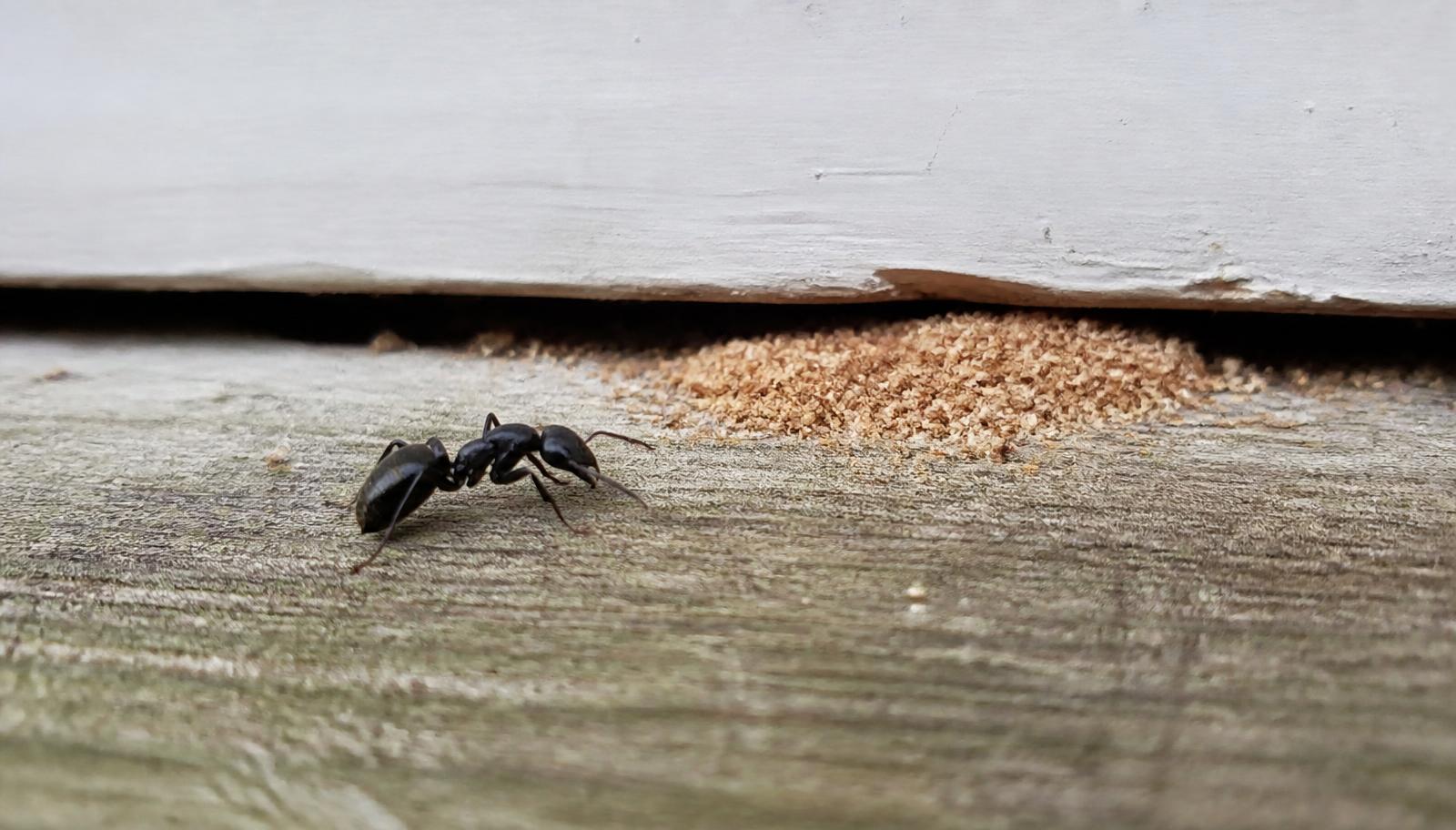
- Look for frass. Carpenter ants do not eat wood, so they dump the shavings. Small piles that look like fine sawdust mixed with insect parts below a slit in wood trim, a windowsill, or a deck joist mark an active gallery above.
- Check the moisture map of your house first. Around dishwashers and sinks, under bathrooms, at door thresholds, in the attic near roof leaks, and anywhere gutters overflow. Damp wood is nest real estate.
- Tap and listen. A screwdriver handle tapped along suspect wood produces a hollow sound over galleries, and a disturbed nest makes a faint dry rustle.
- Look outside the house. Parent colonies commonly live in stumps, woodpiles, landscape ties, and dead tree limbs within about 100 yards, sending workers and satellite colonies into the house. Treating inside while ignoring the stump by the fence loses the war.
Carpenter ants or termites: how do I tell the difference?
Carpenter ants have a pinched waist, elbowed antennae, and front wings longer than the hind wings, while termites have a straight thick waist, straight antennae, and four equal wings. The damage differs too: carpenter ant galleries are smooth and clean with dumped frass, termite galleries are rough and packed with mud.
This distinction matters because the treatments are completely different, and so is the urgency. Both insects mean wood and moisture problems, but termites eat the structure around the clock while carpenter ants excavate it more slowly. If you are seeing mud tubes on the foundation or piles of equal-length wings, stop reading this article and get a termite inspection. If you are not sure which one you have, that is exactly what a free estimate visit answers.
| Sign | Carpenter ants | Termites |
|---|---|---|
| Waist | Pinched and narrow | Thick and straight |
| Antennae | Elbowed | Straight |
| Wings | Front pair longer than hind pair | All four equal length |
| Wood damage | Smooth clean galleries, sawdust-like frass dumped outside | Rough galleries packed with mud, no frass piles |
| What they do with wood | Nest in it, do not eat it | Eat it |
How much damage can carpenter ants do to a house?
A mature carpenter ant infestation can structurally weaken window frames, sills, joists, and deck framing over a period of years, though the damage accumulates far more slowly than termite damage. The bigger warning is what carpenter ants tell you: they nest in damp wood, so an active nest almost always marks a moisture problem that is doing its own damage.
The realistic worry for most Long Island homeowners is not the house collapsing, it is the compounding repair bill. The leak that softened the sill plate keeps leaking, the galleries keep expanding season after season, and by the time a contractor opens the wall, you are replacing framing instead of trim. Colonies are long-lived. A nest that produces swarmers has typically been in place for three years or more, which means the moisture problem has too.
What does professional carpenter ant treatment involve on Long Island?
Professional carpenter ant treatment means locating the nest, treating it directly, and using non-repellent products the colony carries home, then fixing the moisture that invited the ants in.
Full details are on our carpenter ant treatment page.
Here is what a carpenter ant job looks like when we run it start to finish.
- Inspection and nest location. We trace trails, probe suspect wood, and map both the indoor satellite nests and the likely parent colony outside. The estimate is free and the price is quoted in writing before any work begins.
- Direct nest treatment. Dust or foam applied into wall voids, galleries, and nest sites, which kills the colony where it lives instead of where it forages.
- Non-repellent perimeter and trail treatment. Products the ants cannot detect, carried back through the colony, including to the queen. This is the opposite of what a store spray does.
- Baiting where conditions call for it. Slow-acting baits placed on active trails so foragers feed the colony the treatment.
- The moisture conversation. We show you the conducive conditions we found, the leak, the grade, the gutter, the woodpile against the siding, because treatment plus a fixed moisture problem is what keeps them from coming back.
- Guarantee and follow-up. Carpenter ant pricing depends on the size of the structure, the extent of the nesting, and how much of the wood is involved, and it is quoted in writing after a free inspection. The work carries a written 6-month guarantee with return visits at no charge if activity resumes.
How do you keep carpenter ants from coming back?
You keep carpenter ants out by removing the two things they need: damp wood and a way in. Fix leaks, break wood-to-ground and branch-to-roof contact, and keep food sealed so foragers find nothing worth reporting back.
Everything on this list is a moisture or contact problem. Fix leaks fast, especially roof, gutter, and plumbing leaks that wet structural wood. Trim branches so no tree touches the house, because overhanging limbs are the highway carpenter ants use to bypass any ground treatment. Move firewood and lumber off the ground and away from the siding, get stumps ground out instead of left to rot, and keep mulch pulled back a few inches from the foundation. Inside, wipe up sweet spills and seal food, because foragers that find nothing move on.
None of this substitutes for eliminating an existing colony, and an established nest will not leave because you fixed a gutter. The order of operations that works is treat the colony first, then close the conditions behind it. If you are seeing large black ants indoors this season, or you found even one pile of frass, that is worth a phone call before it becomes a framing repair. Answers to more general ant questions are on our ant exterminator page.
Frequently Asked Questions
What is the fastest way to get rid of carpenter ants?
The fastest reliable way is professional treatment of the nest itself with non-repellent products and dusts, which typically knocks activity down within days and eliminates the colony within a few weeks. DIY sprays feel faster because dead ants appear immediately, but they leave the queen and colony intact, which is why the ants return.
Do carpenter ants go away on their own?
No. An established colony is nesting in your structure because it found moisture, shelter, and food, and none of those change on their own. Colonies persist for years, grow each season, and eventually release swarmers that can found satellite nests elsewhere in the house.
Should I be worried if I see one big black ant in my house?
One or two large black ants in summer can just be foragers from an outdoor colony checking your kitchen. Repeated sightings, ants appearing in winter or early spring, or any winged ants indoors are a different story, because those patterns point to a nest inside the structure and are worth an inspection.
What attracts carpenter ants to a house?
Moist or water-damaged wood is the main draw, followed by accessible food, especially sweets and proteins, and easy entry routes like tree branches touching the roof, firewood against the siding, and gaps around doors, windows, and utility lines.
Do carpenter ants mean my house has rotted wood?
Very often, yes. Carpenter ants strongly prefer to start galleries in wood that is already softened by moisture, so an active indoor nest is a reliable flag that something is leaking or staying damp. Finding and fixing that moisture source is part of any treatment that lasts.
How long does it take to get rid of carpenter ants?
Most treated infestations are fully resolved within 2 to 8 weeks, with activity dropping sharply in the first week as the products move through the colony. Our carpenter ant work carries a written 6-month guarantee, so if activity resumes in that window, we come back at no charge.
Does homeowners insurance cover carpenter ant damage?
Almost never. Insurers treat insect damage as preventable maintenance rather than a sudden covered event, which is the same position they take on termite damage. That is a strong argument for dealing with an infestation early, while the fix is a treatment bill instead of a carpentry bill.
Seeing big black ants indoors, or sawdust that nobody made? Get a free estimate.
Nassau and Suffolk homeowners: call and describe what you are seeing, and we will tell you honestly whether it sounds like carpenter ants, regular ants, or termites, and quote the job in writing before any work begins. Every carpenter ant job is backed by a written 6-month guarantee.
This article is general pest information for Long Island homeowners, not a diagnosis of your specific situation. Pest behavior varies by home, season, and species, and every job is quoted in writing before any work begins. Pesticide applications are performed by licensed New York State applicators in accordance with label requirements.