How Do Exterminators Get Rid of Mice? The 5-Step Process We Use in Long Island Homes (2026)
By the Bobby Bugs Team, Licensed New York State Pest Control Applicators, Serving Nassau, Suffolk, Queens & The Bronx
9 min read
Key takeaways
- Getting rid of mice permanently is an exclusion job, not a poison job. If the entry points stay open, new mice replace the ones you remove.
- A mouse fits through a gap the width of a dime, about a quarter inch. That is why homeowners who "checked everywhere" still have mice.
- Long Island mouse pressure peaks from October through March, when dropping temperatures push mice indoors, but established nests are active year-round.
- One mouse is rarely just one. A female house mouse can produce a litter of around 6 pups every 3 weeks in a warm house.
- Peppermint oil, ultrasonic plug-ins, and mothballs do not clear an active mouse problem. No repellent replaces sealing the hole.
- Bobby Bugs quotes mouse work in writing, for free, before any work begins, with a 60-day written guarantee included.
How do exterminators get rid of mice?
Exterminators get rid of mice with a 5-step process: a full inspection to find nesting and entry points, exclusion work that seals every gap larger than a quarter inch, strategic trapping along the routes mice actually travel, sanitation and monitoring, and follow-up visits until activity reads zero. Sealing the entry points is the step that separates permanent results from a problem that comes back every fall.
Here is the exact process we run in Nassau and Suffolk County homes, and the honest reason each step exists.
- Inspection. We walk the whole structure, inside and out: foundation line, garage door sweeps, utility and AC line penetrations, the boiler room, the attic, under sinks, behind the stove and refrigerator. We are reading droppings, rub marks, and gnaw marks to map where mice nest and how they travel. Everything else depends on getting this map right.
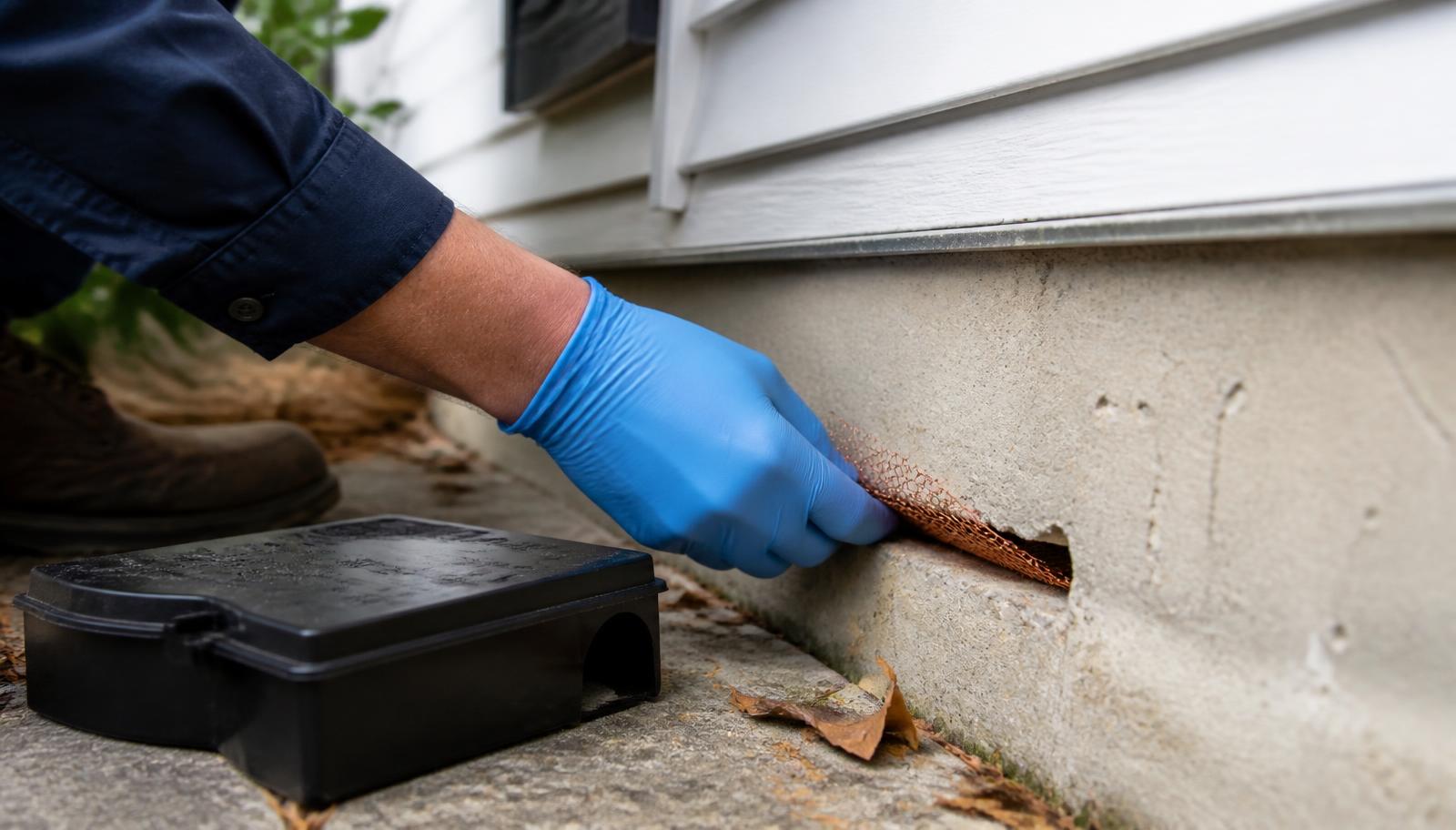
- Exclusion, meaning we seal the entry points. Every gap a dime can pass through gets closed with materials mice cannot chew through, like copper mesh and metal, not the foam and steel wool alone that fail within a season. This is the step that makes results permanent, and it is the step most poison-only services skip entirely.
- Trapping along the runways. Mice travel the same wall-hugging routes every night and rarely venture more than about 25 feet from the nest, so trap placement matters far more than trap count. We place snap traps and stations directly on the mapped runways, where they work in days, not weeks.
- Sanitation and monitoring. Droppings and nesting material get removed so we can tell old evidence from new activity, food sources get sealed away, and monitoring stations tell us honestly whether the population is falling.
- Follow-up until it reads zero. We come back, check every station, refresh what needs refreshing, and verify no new droppings and no new gnawing. With our 60-day written guarantee, if mice return within 60 days, so do we, free.
How do I know if I have mice in my walls?
The telltale signs of mice in your walls are scratching, skittering, or light gnawing sounds at night, especially in the first hours after the house goes quiet, droppings the size of rice grains along baseboards and under sinks, a musky ammonia-like odor in enclosed spaces, and gnaw marks on food packaging, wires, or wood. Sounds concentrated in one wall section or ceiling corner usually point to a nesting site nearby.
The nighttime timing is the giveaway. Mice are most active in the hours after lights-out, so scratching at 11 PM that stops by morning is classic mouse behavior, while daytime scratching is more often squirrels in the attic, which is a different problem with a different solution. On Long Island we get the most wall-noise calls in October and November, right when the first cold nights send mice looking for a warm place to spend the winter, and your walls are exactly that.
How do mice get into Long Island houses?
Mice get into Long Island homes through gaps as small as a quarter inch, about the width of a dime: worn garage door sweeps, gaps where AC lines, gas lines, and dryer vents pass through the foundation, cracked foundation corners, gaps under siding, and unscreened attic and crawl space vents. When overnight temperatures start dropping in October, the mice that spent summer outside follow the warm air leaking out of those gaps straight inside.
The homes we treat most across Nassau and Suffolk are not run-down. They are ordinary colonials, capes, and splits where forty years of cable installs, AC replacements, and deck additions have left a dozen quiet penetrations nobody caulked. Add a garage door that sits an inch proud of the slab in one corner and firewood stacked against the siding, and you have a highway. This is why our inspection circles the outside of the house before we ever set a trap inside.
Will mice go away on their own?
No. Once mice are nesting inside a heated home with food and water, they have zero reason to leave, and their numbers grow instead. A female house mouse can have a litter of around 6 pups every 3 weeks, and those pups can begin breeding at about 6 weeks old, which is how a couple of mice in the fall becomes a full infestation by spring.
Mice going quiet is not mice moving out. A stretch of silence usually means they shifted to a different wall bay, found a new food source, or simply got harder to hear. The droppings tell the real story, which is why we clean up old evidence during treatment, so any new droppings are proof of live activity instead of a guessing game. If you heard them in November and it is quiet in January, assume the nest is still there until an inspection says otherwise.
What smells keep mice away? The honest answer
No smell reliably keeps mice out of a house. Peppermint oil, mothballs, dryer sheets, ammonia, and ultrasonic repellers all fail against an established mouse population, because the reward of a warm nest with food outweighs a bad odor, and mice habituate to smells and sounds within days. At best, strong scents briefly shift activity a few feet.
We would happily sell you a peppermint service if it worked. It does not, and any company telling you otherwise is selling air freshener. The uncomfortable truth is that the fix for mice is physical: seal the gaps, remove the mice already inside, and confirm with monitoring. Save the peppermint oil for your tea and spend that energy checking your garage door sweep, which will do more for you than every repellent on the shelf combined.
Do exterminators use poison for mice, and should you?
Poison alone is the most common way mouse jobs go wrong. Rodenticide-only treatments leave the entry points open, so new mice keep arriving, and poisoned mice frequently die inside wall voids, where the odor can linger for weeks with no practical way to remove them. Unsecured poison is also the number one avoidable hazard to kids, pets, and Long Island raptors like owls and hawks that eat poisoned rodents.
In residential work we lead with snap traps on the runways and exclusion at the entry points, because that combination removes mice quickly, verifiably, and without mystery odors in February. Where bait is genuinely appropriate, it goes in locked, tamper-resistant stations, placed where children and pets cannot reach, in line with the product label. If a company's entire mouse plan fits inside a bait box, they are planning to see you again every year, and not for free like we do under our guarantee.
How long does it take an exterminator to get rid of mice?
With trapping and exclusion done properly, most Long Island homes see mouse activity drop sharply within the first week and reach zero in about 1 to 3 weeks, confirmed by a follow-up visit. Larger or long-established infestations, and homes where exclusion uncovers many entry points, can take longer, which is exactly what the free quote and inspection sort out up front.
The first 48 hours after a proper trap placement are usually the busiest, because we are intercepting mice on routes they already trust. What stretches a job out is almost never the trapping, it is discovering that a house has been feeding the same nest for years. Either way, the 60-day written guarantee means the timeline is our responsibility. You are not paying per visit while we get it right.
How much does a mouse exterminator cost on Long Island?
Mouse cost on Long Island depends on the size of the home, how much entry-point sealing the exterior needs, whether it is an apartment or a single family house, and how many follow-up visits it takes to read zero. National averages published online often do not match Long Island reality. Bobby Bugs quotes every job in writing, for free, before any work begins, and the price on the invoice matches the quote, with a 60-day written guarantee.
National cost guides quote wide ranges for mouse extermination because companies add exclusion work and follow-up visits as separate line items. We fold the follow-ups and standard exclusion into one flat number on purpose, because a mouse job without sealed entry points is not finished, and we would rather guarantee a finished job than advertise a cheap unfinished one. Rat work is priced separately since it involves different equipment and bait stations, and that quote is also free.
If you are dealing with insects too, remember that one cockroach usually means more, and you can browse our full list of pest control services for everything else we handle on Long Island.
Frequently Asked Questions
Does one mouse mean an infestation?
Treat one mouse as a warning shot, not a fluke. Mice are social, nocturnal, and fast-breeding, so a single daytime sighting or a few droppings often means an established nest nearby. Set the sighting against the calendar too: one mouse in November on Long Island almost always has company.
Do mice come back after an exterminator?
Mice come back when the entry points were never sealed. Trapping removes the current population, but only exclusion work keeps the next wave of mice out, which is why it is built into every Bobby Bugs mouse job and why we can offer a 60-day written guarantee.
Are mice dangerous to have in your house?
Yes, beyond the nuisance. Mice contaminate food and surfaces with droppings and urine, they can carry salmonella and other pathogens, and their constant gnawing on wiring is a documented fire hazard. The longer a nest is active, the more insulation, wiring, and stored belongings it damages.
Why are mice worse on Long Island in the fall and winter?
When overnight temperatures start dropping in October, outdoor mice follow warmth and food indoors, and pressure stays high through March. Fall is also the best time to do exclusion work, because sealing entry points before the cold snap prevents the winter wave instead of chasing it.
Will getting a cat solve a mouse problem?
No. A cat may catch the occasional bold mouse, but it cannot reach nests inside wall voids, and studies of working cats show they rarely eliminate established indoor populations. Plenty of the Long Island homes we treat have cats sleeping ten feet from the traps.
What should I do if I hear scratching in my walls at night?
Note which wall and what time, check nearby baseboards and under-sink cabinets for rice-grain droppings, and do not put poison in the wall void. Then get an inspection: nighttime scratching is usually mice, daytime is often squirrels, and the treatments are completely different. Bobby Bugs quotes are free either way.
What does the Bobby Bugs 60-day mouse guarantee cover?
If mouse activity returns within 60 days of your treatment, we come back and re-treat at no additional cost. The 60-day written guarantee is included in the quoted price of every mouse job, apartment or house, and it is printed on the invoice.
Hearing scratching at night? Get a free quote before the nest grows.
Nassau and Suffolk County homeowners: tell us what you are hearing and seeing, and we will tell you honestly whether it is mice, what it takes to fix it, and the price in writing before we start. Sealed entry points, a 60-day written guarantee, and a licensed applicator answering the phone, not a call center.
This article is general pest information for Long Island homeowners, not a diagnosis of your specific situation. Pest behavior varies by home, season, and species, and every job is quoted in writing before any work begins. Pesticide applications are performed by licensed New York State applicators in accordance with label requirements.