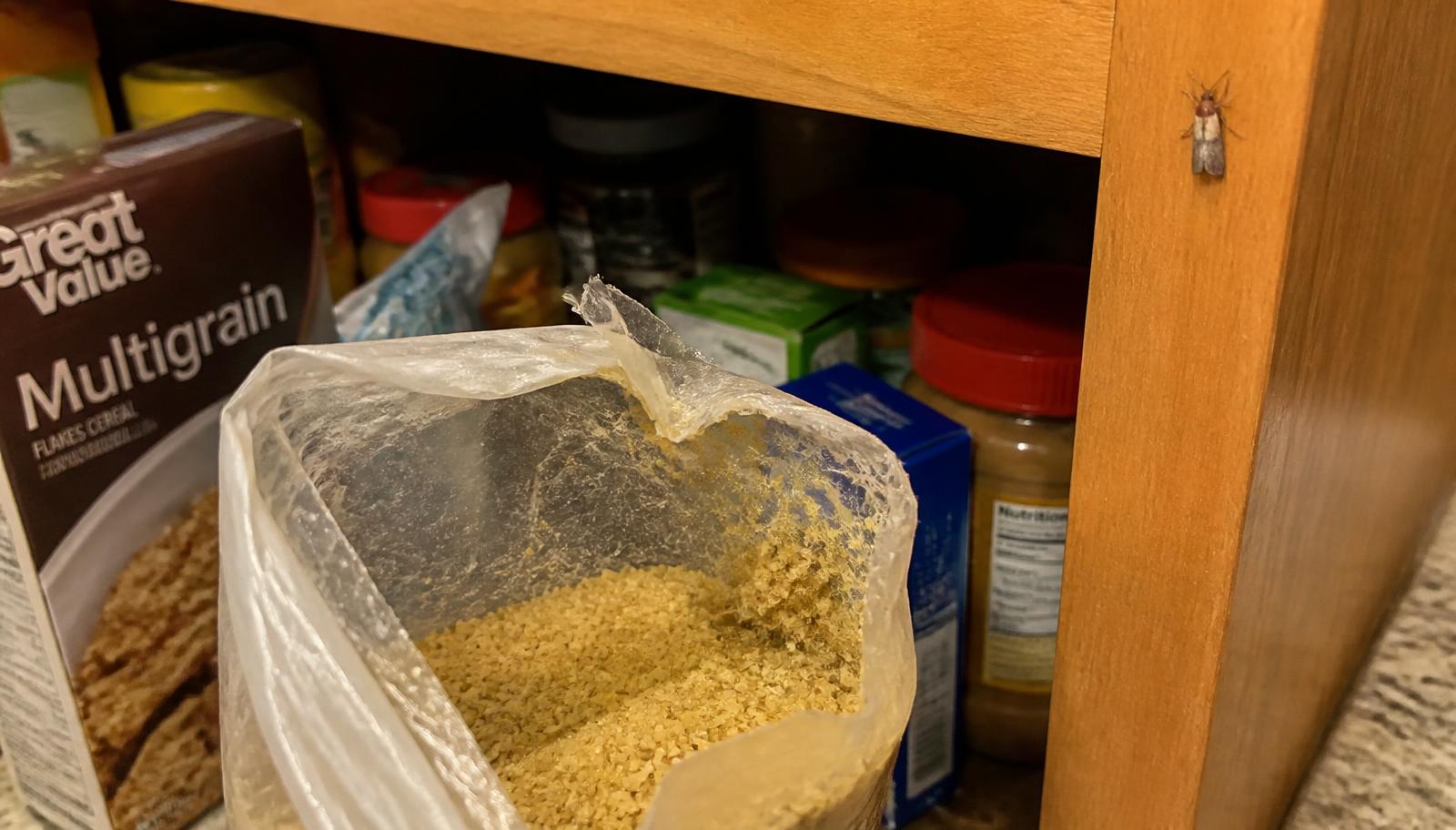
How Do You Get Rid of Pantry Moths? The Complete Long Island Guide to Meal Moths, Why They Keep Coming Back, and What the Traps Are Really Doing (2026)
By the Bobby Bugs Team, Licensed New York State Pest Control Applicators (NYSDEC Business Reg. 1825832), Serving Nassau, Suffolk, Queens & The Bronx
10 min read
Key takeaways
- Pantry moths come home from the store. Eggs are laid on packaging and grain at the mill, warehouse, or shelf, and a sealed box of birdseed, rice, or dog food is the usual carrier.
- Indian meal moths are the common Long Island species. Adults are about half an inch across with a distinctive two tone wing: pale gray toward the body, coppery bronze toward the tip.
- The larvae leave the food. They crawl away to pupate on ceiling corners, cabinet edges, hinges, and under shelf liners, which is why they reappear after you throw out the pasta.
- Adult moths do not eat and do not damage anything. They exist to mate and lay a few hundred eggs, so swatting them is not treatment.
- Pheromone traps only attract males. They are monitoring tools that tell you whether activity is continuing, and used alone they will not clear an infestation.
- Thin plastic bags and cardboard are not protection. The larvae chew through them. Glass, metal, and thick hard plastic with a real seal are what work.
- Bobby Bugs pantry pest work carries a written 90 day guarantee, because unlike outdoor invaders, this pest breeds inside and can actually be eliminated.
How do you get rid of pantry moths?
You get rid of pantry moths by removing the food source and the hidden cocoons at the same time. Empty every cabinet, inspect every dry good including sealed boxes, discard anything showing webbing, clumping, or larvae, vacuum the empty shelves and every crack, hinge, and screw hole, wipe with soap and warm water, and store what you keep in sealed glass or hard plastic. Then monitor for six to eight weeks, because eggs already laid outside the food will still hatch.
The mistake we see in almost every Long Island kitchen we walk into is a partial job. The homeowner threw out the obvious bag of flour, kept the sealed boxes because they looked fine, and left the shelves in place. A month later the moths are back and they conclude the moths are unkillable. They are not. They are just hiding in three places nobody checked: inside intact packaging, in the seam where the shelf meets the cabinet wall, and up on the ceiling where the larvae went to spin.
The second thing to accept early is that you are going to throw away food you paid for. People try to save a fifteen dollar bag of specialty flour and lose two more months to it. If a package is open, in the same cabinet, and made of grain, nuts, dried fruit, or chocolate, the honest move is to bag it and put it in the outside trash today.
Where do pantry moths come from?
Pantry moths come from the food you brought into the house. Female Indian meal moths lay eggs on grain and packaging at the processing plant, in the warehouse, or on the store shelf, and the eggs and tiny larvae travel home inside a sealed package. They do not come in through a window in any meaningful number, and they are not a sign of a dirty kitchen. The most common carriers on Long Island are birdseed, dry pet food, bulk flour and rice, cornmeal, nuts, dried fruit, pancake mix, and decorative items like dried corn and grain wreaths.
I want to kill the shame part of this right away, because it stops people from calling. We treat pantry moths in brand new kitchens in Manhasset and in fifty year old kitchens in Patchogue, and cleanliness is not the variable. Volume and storage time are. The household that buys in bulk, keeps a fifty pound bag of birdseed in the garage, or has a spice from 2019 in the back of a cabinet is the household that gets meal moths, because the pest needs uninterrupted time inside a package to complete a generation. A tidy pantry with old inventory is still an infested pantry.
Why do pantry moths keep coming back after I throw out the food?
They keep coming back because mature larvae leave the food before they pupate. They crawl out of the box, travel across the shelf and up the wall, and spin their cocoons on ceiling and wall corners, cabinet edges, hinges, shelf pin holes, and under shelf liner. Throwing away the infested food removes the current generation's kitchen but leaves the next generation attached to your woodwork, and those adults emerge, mate, and lay eggs on whatever dry goods you replaced.
The other reason is a second source you have not opened. Sealed boxes are not proof of anything, because eggs were often laid before the box was sealed and the larvae chew through liners and thin plastic from the inside. When we inspect, the second source is very often not in the pantry at all. It is birdseed in the garage, a bag of dog food in the mudroom, a bin of grass seed, a decorative gourd or Indian corn arrangement, or a bag of rice in a basement pantry shelf nobody thinks of as food storage.
And the third reason, the one people find hardest to hear: patience. Even a correct, complete clear-out produces stray moths for several weeks while eggs that were already laid outside the discarded food finish hatching. Seeing a moth on day ten does not mean the job failed. Seeing steady numbers on day forty five does.
Do pantry moth traps actually work?
Pheromone traps work as monitors, not as control. The sticky trap is baited with the female sex pheromone, so it catches male moths only. Females continue laying regardless, and the eggs and larvae inside your food are unaffected by the trap. Traps are genuinely useful for one thing, which is telling you whether activity is rising, falling, or finished after you have done the clear-out.
Put one or two traps in the pantry area after the clean-out, date them, and check the count weekly. A trap catching nothing for three consecutive weeks is real evidence you are clear. A trap that keeps catching means there is still a source, and the answer is another inspection, not another trap. One warning: hanging traps in an untreated kitchen can also draw males in from an adjacent apartment or a nearby source, which is worth knowing in a co-op or condo in Queens or Nassau where units share walls.
How long does it take to get rid of pantry moths?
Expect three to six weeks to see the end of it after a thorough clear-out, and plan on monitoring for eight weeks before calling it done. In a warm kitchen an Indian meal moth completes a full generation from egg to adult in roughly six to eight weeks, and faster in summer heat, so any eggs that were already laid when you cleaned will still produce moths for a while after everything looks clean.
Time is also the reason a half measure is so expensive. Every generation you allow to complete puts a few hundred more eggs into the room. In cool storage, like an unheated garage or a basement shelf on Long Island in winter, development stretches out for months, which is why a garage birdseed source can quietly feed a kitchen problem all season. That timeline works in your favor once the food is gone, because with no food there is no next generation.
How do you clear a pantry properly, step by step?
A proper pantry clear-out is eight steps, and the vacuuming step is the one that decides whether the moths come back.
Work through these in order, and do not skip ahead to restocking until the cabinets are empty, vacuumed, and washed.
- Take everything out. Every cabinet, every shelf, including canned goods and the items on the far end. You cannot inspect a pantry you are looking into, only one you have emptied.
- Inspect every dry good, including sealed packages. Look for fine silk webbing, grain clumped together in strands, small cream colored larvae with dark heads, and shed skins or sawdust-like frass. Check flour, rice, pasta, cereal, oats, cornmeal, pancake mix, nuts, dried fruit, chocolate, spices, tea, birdseed, pet food, and grass seed.
- Bag the infested items and take them outside now. Seal them in a bag and put them in the outdoor trash, not the kitchen can. Anything open, grain based, and sitting in the affected cabinet should go, even if it looks clean.
- Freeze what you want to keep. Sealed dry goods you are not ready to throw out can be held in a freezer at zero degrees Fahrenheit for one full week, which kills eggs and larvae. Then move them straight into sealed containers.
- Vacuum the empty cabinets. Use a crevice tool on shelf edges, the wall to shelf seam, corners, shelf pin holes, hinge recesses, and under any shelf liner. This is the step that removes cocoons, and it is the step almost everyone skips. Empty the vacuum outside afterward.
- Wash the surfaces. Warm water and soap, or a vinegar solution, on shelves and door interiors. Do not use pesticide sprays on food contact surfaces or inside food storage areas.
- Check outside the kitchen. Garage and mudroom birdseed and pet food, basement shelving, grass seed, decorative dried corn, wreaths, and potpourri, and the pantry of the room above or beside it in an apartment.
- Restock into sealed containers and set monitors. Glass jars, metal tins, or thick hard plastic with a gasket lid. Thin bags and cardboard do not stop larvae. Add one or two pheromone traps, date them, and check weekly for eight weeks.
What does a professional pantry pest treatment look like?
A professional pantry pest treatment is an inspection driven job: find every producing package in the house, treat the cracks and voids where larvae pupate, and back it with a written guarantee.
Pantry pest work on Long Island is quoted per job after an inspection, with the price driven by how many cabinets and storage areas are involved and whether the source has already spread beyond the kitchen. See our pantry pest treatment on Long Island for the full scope.
Here is what a Bobby Bugs pantry pest visit includes.
- Free phone triage. Describe the moth and where you are seeing it. Meal moths, clothes moths, and small flying beetles get very different responses, and we would rather sort that out on a call than sell you a visit you do not need.
- A full cabinet and dry goods inspection. We go through the kitchen and every secondary storage area in the home, including garage and basement food, seed, and pet supplies, and we show you exactly which items are producing.
- Straight guidance on what goes and what stays. No blanket order to throw out the entire pantry, and no pretending a webbed bag of flour can be saved.
- Vacuuming and crack and crevice treatment. Cabinet seams, hinges, shelf pin holes, and voids get treated, along with an insect growth regulator where appropriate to stop larvae from reaching adulthood. Nothing is applied to food or to food contact surfaces, and everything is done to label by a licensed New York State applicator.
- A written 90 day guarantee. The price is in writing before we start and the invoice matches the quote. If activity resumes inside 90 days, we come back at no charge, because unlike an outdoor invader this pest breeds inside and can genuinely be eliminated.
How do you keep pantry moths from coming back?
Prevention is storage, buying habits, and a twice yearly cabinet check, in that order.
Storage is the whole strategy. Move flour, rice, pasta, cereal, oats, cornmeal, nuts, dried fruit, and pet treats into glass, metal, or hard plastic with a sealing lid the day they come home. Containers are not about tidiness, they are a physical barrier, and they also contain a problem that arrives inside one package instead of letting it spread to twelve.
Buy grain products in quantities you will actually use within a couple of months, and rotate so the oldest package gets opened first. Bulk buying is the single most common way meal moths enter a Long Island home. When you bring home birdseed, grass seed, or a large bag of dry pet food, either store it in a sealed bin or freeze it for three to four days first, since those three products carry more infestations than anything in the kitchen.
Check the back of the cabinet twice a year and throw out spices, mixes, and specialty flours that have gone past their date. Wipe up spilled grain and flour dust in the pantry, because loose flour in a shelf seam is enough to support a generation on its own. Keep one pheromone trap running as an early warning system.
The goal is not a moth-free house forever. It is catching the next infested bag in week one instead of month three. If what you are seeing turns out to be beetles rather than moths, or if the problem is in a basement or garage food store, the same principles apply and the same treatment covers it, and if the bugs you are finding are downstairs rather than in the kitchen, read our guide to basement bugs. See our full list of pest control services.
Frequently Asked Questions
Where do pantry moths come from?
They come home inside packaged food. Indian meal moths lay eggs on grain and packaging at the mill, in the warehouse, or on the store shelf, and the eggs or young larvae travel in with the box or bag. Birdseed, dry pet food, bulk flour and rice, nuts, dried fruit, and decorative dried corn are the most common carriers. They are not a sign of a dirty kitchen.
Do I have to throw out all my food?
No, but you should throw out everything that is open, grain based, and in the affected cabinet, plus any package showing webbing, clumping, or larvae. Unopened items in glass or metal are usually fine, and sealed dry goods you want to keep can be frozen at zero degrees Fahrenheit for a week to kill eggs and larvae before you move them into sealed containers.
Do pantry moth traps get rid of pantry moths?
No. Pheromone traps are baited with the female scent and catch only male moths, so females keep laying and the larvae inside your food are untouched. Traps are valuable as monitors: after a full clear-out, a trap that catches nothing for three straight weeks is good evidence the infestation is over, and one that keeps catching means there is still a source to find.
How long do pantry moths last?
Expect stray moths for three to six weeks after a thorough clear-out and plan to monitor for eight weeks. A full generation from egg to adult takes roughly six to eight weeks in a warm kitchen, faster in summer, and considerably longer in a cool garage or basement, which is why an overlooked bag of birdseed can feed a kitchen problem for months.
Do pantry moths eat clothes?
No. Pantry moths, also called Indian meal moths, feed only on stored food products as larvae, and the adults do not feed at all. Clothes moths are a different species that attacks wool, silk, and other natural fibers in closets. If the damage is to fabric rather than food, you are dealing with a clothes moth, not a pantry moth.
Can pantry moths get into sealed packages?
Yes. Meal moth larvae chew through paper, cardboard, cellophane, and thin plastic bags, and eggs are frequently laid before a package is sealed at the plant. Only glass, metal, and thick hard plastic with a gasket lid are reliable barriers, which is why moving dry goods out of their original packaging is the core of prevention.
How much does pantry pest treatment cost on Long Island?
Pantry pest jobs are quoted in writing after an inspection, with price driven by how many cabinets and storage areas are involved and whether the infestation has spread outside the kitchen. Bobby Bugs quotes every job in writing before any work begins, the invoice matches the quote, and the treatment carries a written 90 day guarantee.
Third bag of flour this month? Get a free quote and end it properly.
Nassau and Suffolk County homeowners: we will inspect every cabinet and every secondary food store in the house, show you exactly which package is producing the moths, treat the cracks and hinges where the larvae pupate, and put the price in writing first. Licensed New York State applicators, nothing sprayed on food, and a written 90 day guarantee.
This article is general pest information for Long Island homeowners, not a diagnosis of your specific situation. Pest behavior varies by home, season, and species, and every job is quoted in writing before any work begins. Pesticide applications are performed by licensed New York State applicators in accordance with label requirements.