Why Are There Bugs in My Basement? The 7 Bugs Long Island Homeowners Find Downstairs, What Each One Means, and How to Get Them Out (2026)
By the Bobby Bugs Team, Licensed New York State Pest Control Applicators (NYSDEC Business Reg. 1825832), Serving Nassau, Suffolk, Queens & The Bronx
10 min read
Key takeaways
- Basement bugs are moisture pests. House centipedes, camel crickets, silverfish, springtails, sowbugs, and earwigs all need damp conditions, and all of them come from outside.
- The bugs you see are the survivors. Sowbugs and springtails die within days indoors, so finding live ones means there is an active moisture route into the space.
- A house centipede is a predator. Seeing them regularly means something else down there is feeding them, so treat the centipedes as an alarm rather than the problem.
- Late August through October is the heaviest season on Long Island. Soil cools, the ground dries after summer, and outdoor insects push toward the warm, humid foundation.
- Indoor spraying is the least effective place to put product. It kills what is on the floor right now and does nothing about the perimeter the bugs keep crossing.
- A dehumidifier holding the basement under 50 percent relative humidity does more long term work than any can of spray you can buy.
- Bobby Bugs quotes general insect work in writing before any treatment, and we are straight about the fact that a one time occasional invader service carries no guarantee, because we cannot guarantee your neighbor's mulch bed.
Why are there bugs in my basement?
There are bugs in your basement because it is the coolest, dampest, darkest room in the house and it shares a wall with wet soil. Insects that live outdoors in mulch, leaf litter, and the top few inches of ground move toward that moisture, find a crack where the block wall meets the slab or a gap around a pipe, and walk in. Once inside they stay alive because basement humidity is high enough to keep them from drying out.
I will give you the honest version first, because most homeowners have it backwards. This is not about cleanliness. We treat spotless finished basements in Garden City and we treat cluttered crawl spaces in Mastic, and both get the same list of bugs. What separates a basement with a bug problem from one without it is water and openings. Grading that slopes toward the house, gutters dumping at the corner instead of six feet out, a downspout that ends at the foundation, mulch piled against the siding, a cracked window well, a dryer vent gap, a sump that runs constantly. Those are the actual causes.
The second thing worth understanding is that most of these insects are not living in your basement in the sense of breeding there. They are wandering in, dying slowly, and being replaced by the next one. That is why homeowners tell us they vacuum them up and see more the following week. You are not looking at a colony that grew inside the house. You are looking at a doorway.
What are the bugs in my basement? The 7 we find most on Long Island
Seven insects account for nearly every basement call we take on Long Island, and each one tells you something specific about the house.
Ground beetles, pillbug-eating carabids, clover mites, and the occasional stray cockroach also turn up on Long Island, and if what you are finding is a cockroach rather than a beetle, that is a different problem with a different treatment, so read our article on whether one cockroach means an infestation.
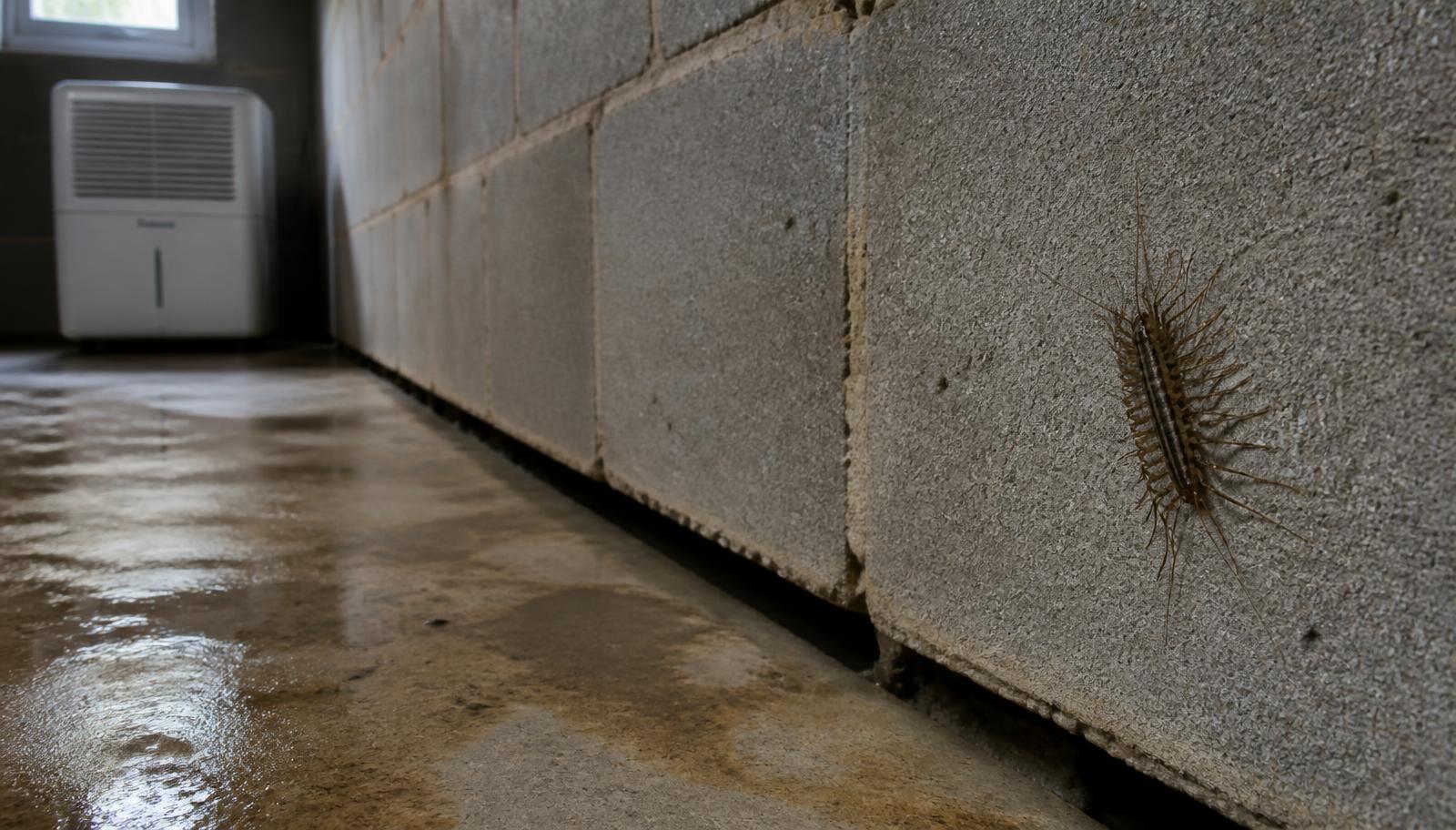
- House centipede. A fast, flat, tan and striped insect with very long legs, up to fifteen pairs on an adult, that darts along the wall and stops dead when the light goes on. Harmless to your house and to your structure. It is a predator, and it is in your basement because there is prey down there. Finding them regularly is an alarm bell about the other six items on this list.
- Camel cricket, also called a spider cricket or sprickett. Humpbacked, wingless, tan and mottled, with long back legs and no chirp. They jump toward whatever startles them, which is why people hate them more than any other basement insect. They feed on fungus, cardboard, fabric, and paper, and they thrive in unfinished basements, crawl spaces, and garages. Late summer and fall is when they surge indoors.
- Silverfish. A teardrop shaped, metallic gray, wingless insect that moves in a fish-like wiggle and hides in cardboard, books, and stored paper. They feed on starches, paper, glue, and wallpaper paste, they need consistently damp air, and they live for years. Silverfish are the clearest humidity signal on this list.
- Springtail. A speck-sized jumping insect, roughly one sixteenth of an inch, that shows up by the hundreds around sump pits, floor drains, damp concrete, and bathroom baseboards. People often mistake them for fleas. They cannot survive dry air, so a springtail bloom indoors means standing moisture within a few feet.
- Sowbug and pillbug. Gray, armored, segmented crawlers, the ones that roll into a ball. They are not insects at all, they are land crustaceans with gills, which is why they die within a day or two of getting into a dry room. Live ones inside mean an active damp entry point, usually the wall to floor joint or a window well filled with leaves.
- Earwig. Dark reddish brown with pincers on the tail end. They are harmless, and no, they do not crawl into ears. They hide under mulch, stone, and firewood by day and follow moisture indoors at night through door sweeps and slider tracks.
- Cellar spider. The long legged spider spinning loose, messy webs in the corners of the ceiling and stairwell. It eats the other six. Like the centipede, a heavy cellar spider population is a symptom of a food supply, not a cause.
Are house centipedes dangerous, and should I kill them?
House centipedes are not dangerous to people, pets, or your home. They do carry venom that they use on prey, and a large one can pinch if you trap it against your skin, but bites are rare and are usually compared to a mild bee sting. They do not damage wood, wiring, food, or fabric. What they do is hunt the silverfish, springtails, small roaches, and spiders already living in your basement.
I understand nobody wants to share a laundry room with something that moves like that. But the centipede is the most useful bug on the list, and here is the practical takeaway: if you are seeing several a week, you have a prey population you have not found yet. Homeowners who kill only the centipedes almost always call us back about silverfish or crickets a month later. Fix the moisture and the perimeter, the prey disappears, and the centipedes leave on their own because there is nothing left to eat.
What do basement bugs say about my house?
A recurring basement bug problem almost always points to one of three conditions: relative humidity above 60 percent, water being delivered to the foundation from the outside, or an unsealed path from soil to slab. Most Long Island homes with a bug complaint downstairs have at least two of the three, and correcting them does more than any single treatment.
Long Island gives these insects a lot to work with. Older block foundations across Nassau and western Suffolk develop a cold joint where the wall meets the floor, and that joint is a continuous doorway the length of the house. Cape Cods and ranches on the South Shore sit on a high water table with sandy soil that drains fast in summer and stays saturated in spring, which drives ground insects toward the foundation in both seasons. Crawl spaces under additions and under older Levitt-era homes trap humidity against joists with no air movement at all. Add mulch beds that get topped off every spring until they sit above the siding line, and you have built a bridge from the bug's habitat to your sill plate.
The calls cluster. Spring, when snowmelt and rain saturate the soil and push everything up and out. And late August into October, which is the heaviest occasional invader season on Long Island, when soil cools faster than the house does and every ground dwelling insect starts moving toward warmth. If you get bugs in the basement every fall like clockwork, that is not bad luck. That is a predictable seasonal migration hitting a house with open edges.
Why does spraying inside the basement not fix it?
Spraying the inside of the basement fails because the bugs are not living there, they are entering there. An indoor application kills the individuals crossing the treated surface at that moment, and it does nothing to the population outside in the mulch, the leaf line, and the top inch of soil that keeps supplying replacements. Within a week or two, new insects follow the same route in.
The hardware store aisle sells you the wrong geometry. A can of spray is designed to be aimed at a bug you can see, which means it is by definition aimed at the one insect that already made it inside. Meanwhile the actual traffic is happening at the perimeter you never treated: the wall to soil joint outside, the window wells, the slab edge, the utility penetrations, the door thresholds.
There is a second cost to indoor fogging and heavy interior spraying, which is that it puts product where your family spends time to solve a problem that lives outdoors. Licensed applicators treat exteriors and cracks and voids on purpose. It is not caution for its own sake. It is where the bugs are.
What does a professional general insect treatment look like on Long Island?
A professional general insect treatment on Long Island is an exterior first job: identify the entry pattern, treat the perimeter the insects have to cross, and do targeted crack and crevice work inside rather than blanket spraying.
Here is how a Bobby Bugs [general insect treatment on Long Island](/services/insect-exterminator-long-island) runs from the first call to the invoice.
- Free phone triage. Tell us what you are seeing, where, and how many. Most general insect jobs on Long Island can be identified and quoted over the phone in a few minutes, and larger or unclear situations get a free on site inspection.
- Inspection of the exterior first. We walk the foundation looking for the actual entry pattern: the wall to slab joint, utility and hose bib penetrations, window wells, door sweeps and slider tracks, grade and downspout discharge, and mulch or vegetation sitting against the siding.
- Exterior perimeter treatment. A residual application to the foundation band, the soil and mulch line at the base of the wall, window wells, thresholds, and around penetrations. This is the barrier the insects have to cross to reach you, and it is where the majority of the product goes.
- Targeted interior work, not fogging. Crack and crevice application at the sill plate, the wall to floor joint, sump area, and utility chases, plus granular material in window wells or under decks where crickets and centipedes harbor. No blanket spraying of living space.
- A written quote and honest expectations. You get the price in writing before we start, and the number on the invoice matches the quote. We also tell you what treatment alone will not fix, which is a wet basement. If the humidity stays high, some of these insects will keep finding the house.
How much does a one time insect treatment cost on Long Island?
General insect treatment on Long Island is quoted per job, not off a price list. Price moves with the size of the foundation, whether there is a crawl space or an attached garage to include, how much exterior harborage has to be treated, and whether the job is one room or the whole perimeter. Every job is quoted in writing before any work begins.
Activity typically drops sharply within the first seven to ten days after treatment, and seasonal repeat visits are available at the same rate for homes that get hit every spring and fall.
Here is something most companies will not put on their own website. Our general insect service is a one time treatment with no guarantee, and that is deliberate. Occasional invaders are outdoor insects that live in the soil and mulch around every house on the block. We can treat your perimeter, seal advice included, and knock the population down hard. We cannot promise that no cricket will ever come out of your neighbor's leaf pile again. What we can promise is a written price, a licensed applicator, and no invented findings. Pests that do breed inside, like ants, roaches, mice, and pantry moths, come with written guarantees, because those we can actually control.
How do I keep bugs out of my basement for good?
You keep bugs out of the basement by controlling four things in order: the air inside, the water outside, the openings between them, and the harborage you are storing down there.
Start with air. A dehumidifier sized for the space and set to hold relative humidity under 50 percent will do more against silverfish, springtails, sowbugs, and camel crickets than any product, because it removes the condition all four of them need. Empty the bucket or run a condensate line to the sump so the unit actually runs.
Then water outside. Extend downspouts at least four to six feet from the foundation, clean the gutters twice a year on Long Island because of oak and maple leaf load, and regrade so soil falls away from the house rather than toward it. Pull mulch back six inches from the siding and keep it below the sill line. Clear leaves out of window wells and consider covers.
Then openings. Seal the wall to floor joint and any visible foundation cracks, use expanding foam plus sealant around pipe and wire penetrations, install or replace door sweeps on the bulkhead and basement door, repair torn screens on basement windows, and check the dryer vent and hose bib collars.
Then habitat. Cardboard is food and shelter for silverfish and camel crickets both, so move basement storage into plastic bins with lids. Get firewood off the ground and away from the house. Trim vegetation back so it is not touching siding.
Do those four things and the treatment you pay for lasts a season instead of a month. See our full list of pest control services.
Frequently Asked Questions
What are the little bugs in my basement?
The most common are house centipedes, camel crickets, silverfish, springtails, sowbugs and pillbugs, earwigs, and cellar spiders. All seven are moisture pests that live outdoors in soil, mulch, and leaf litter and enter through foundation gaps. Tiny jumping specks near a sump or floor drain are almost always springtails, and hard gray armored crawlers that roll up are sowbugs or pillbugs.
Do bugs in the basement mean my house is dirty?
No. Basement bugs track moisture and entry points, not crumbs. We find the same species in immaculate finished basements and in cluttered crawl spaces. The variables that matter are humidity, grading and drainage outside, mulch against the foundation, and unsealed gaps where the wall meets the floor.
Are house centipedes dangerous?
House centipedes are not dangerous to people or pets and cause no damage to a home. They can pinch if handled, which is rare and roughly comparable to a mild bee sting, and they carry no disease risk. They eat silverfish, springtails, small roaches, and spiders, so a steady centipede presence means there is a prey population in the basement worth addressing.
Why do I get bugs in my basement every fall?
Late August through October is peak occasional invader season on Long Island. Soil cools faster than the house, summer moisture in the ground drops, and ground dwelling insects move toward the warm, humid foundation. Homes with open wall to slab joints, uncovered window wells, or worn door sweeps take the brunt of it every year at the same time.
Will a dehumidifier get rid of basement bugs?
A dehumidifier held under 50 percent relative humidity will substantially reduce silverfish, springtails, sowbugs, and camel crickets over a few weeks, because those species cannot maintain themselves in dry air. It will not stop insects from entering through open gaps, and it does nothing for a wet exterior, so it works best combined with sealing and a perimeter treatment.
Does a one time treatment actually work on basement bugs?
Yes, for the season. A perimeter treatment plus crack and crevice work usually drops activity sharply within seven to ten days. Because these are outdoor insects that keep repopulating the yard, the honest expectation is a strong knockdown that lasts through the season, not permanent elimination, which is why the service is offered without a guarantee and at a repeatable seasonal rate.
How much does an exterminator charge for general insects on Long Island?
General insect treatment is quoted per job after we see the property, with price set by foundation size, crawl space or garage inclusion, and how much exterior harborage needs treating. Bobby Bugs quotes every job in writing before any work begins and the invoice matches the quote.
Tired of sweeping up the same bugs every fall? Get a free written quote.
Nassau and Suffolk County homeowners: tell us what you are finding downstairs and we will tell you honestly what it is, what it says about the house, and the price in writing to treat the perimeter properly. Licensed New York State applicators, exterior first treatment, and a straight answer about what a one time service will and will not do.
This article is general pest information for Long Island homeowners, not a diagnosis of your specific situation. Pest behavior varies by home, season, and species, and every job is quoted in writing before any work begins. Pesticide applications are performed by licensed New York State applicators in accordance with label requirements.