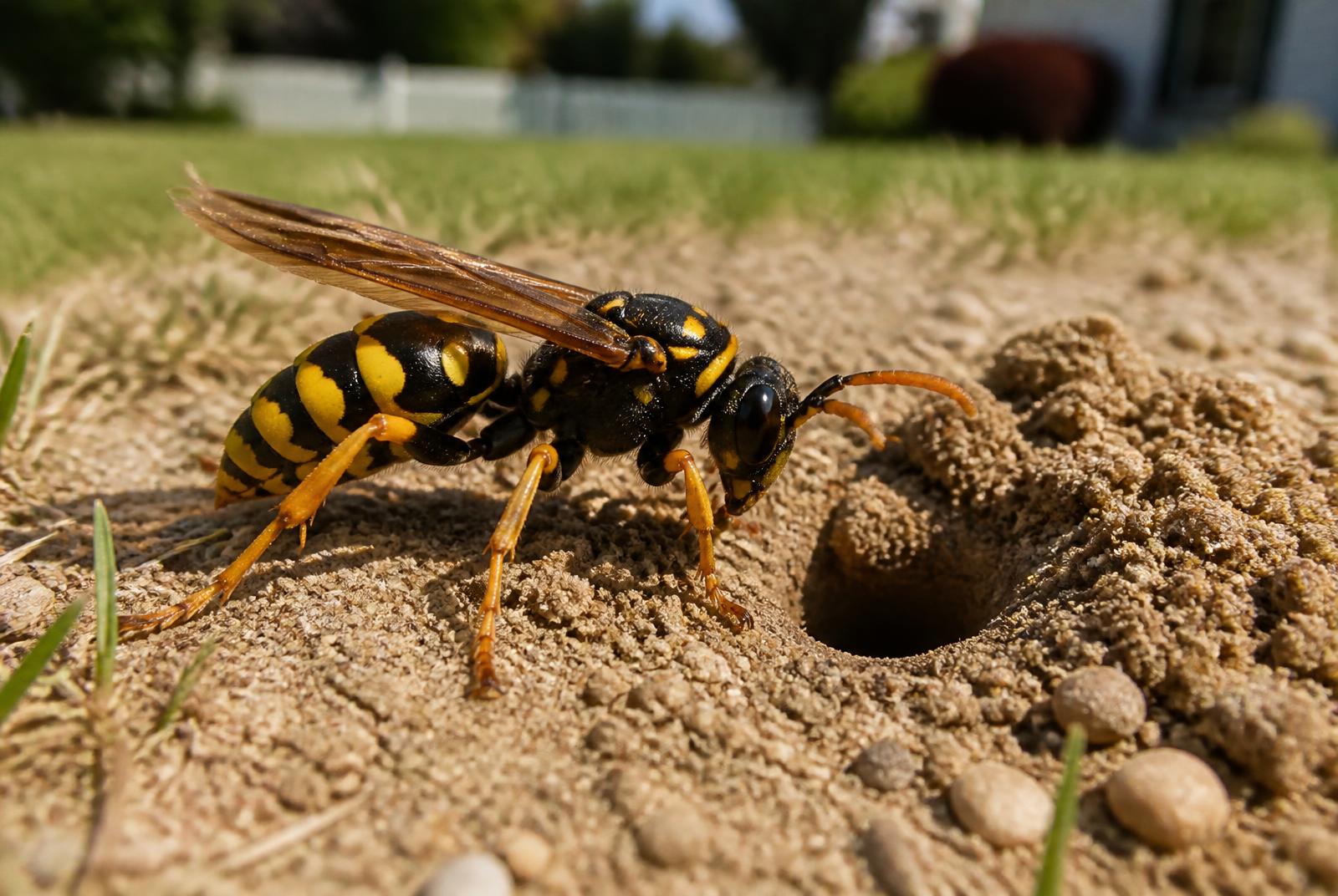
Are Cicada Killer Wasps Dangerous? What Long Island Homeowners Should Know About the Giant Wasps Digging Up the Lawn
By the Bobby Bugs Team, Licensed New York State Pest Control Applicators, Serving Nassau, Suffolk, Queens & The Bronx
10 min read
Key takeaways
- Male cicada killers cannot sting at all. They have no stinger. The aggressive looking hovering and chasing is a territorial display and nothing more.
- Female cicada killers can sting but almost never do. Cornell's New York State IPM program calls them gentle giants. Stings happen when a wasp is grabbed, stepped on, or trapped against skin, not because you walked past a burrow.
- They are solitary. There is no shared nest, so there is nothing for them to defend as a group and no swarm response, which is the thing that makes yellow jackets and hornets dangerous.
- On Long Island they show up in early to mid July and are gone by late August or early September. The lawn holes outlast the wasps.
- Each burrow runs roughly 6 to 10 inches deep and 12 to 18 inches long, with 3 to 4 cells holding 1 to 2 paralyzed cicadas each. A burrow entrance is about an inch and a half across, the size of a quarter or bigger.
- Ground bees in April and May are a different insect, solitary mining bees, and they are even less of a sting risk. They are pollinators and are done in 2 to 4 weeks.
- Treatment is a judgment call, not an automatic. Kids, pools, playgrounds, sting allergies, or a burrow count that grows every summer are the reasons to do it. Otherwise the fix is a thicker lawn.
Are cicada killer wasps dangerous?
Cicada killer wasps are not dangerous to most people. Males cannot sting, and females are very unlikely to sting unless they are handled or stepped on. They do not defend a shared nest the way yellow jackets and bald faced hornets do, so there is no swarm, and they have no interest in your food, your drink, or you. The danger is almost entirely psychological, and it comes from their size.
We get more panicked calls about cicada killers in July than about anything else that flies, and most of the time the first thing we say on the phone is that nobody is in danger. A homeowner sees a wasp the size of their thumb flying at their face, watches it dip into a hole in the lawn, and assumes they have a hornet nest underground. What they actually have is a handful of solitary wasps that spend their short adult lives hunting cicadas out of the trees and dragging them underground to feed their young. When the cicadas stop singing, the wasps are done too.
That said, we are not going to tell you a two inch wasp with a working stinger is a pet. A female can sting, and on Long Island lawns the way it happens is predictable: a kid running barefoot across the burrows, a dog pawing at a hole, or a hand landing on one while gardening. If someone in your house carries an EpiPen for wasp stings, the calculation changes and the burrows should go. We cover exactly when treatment makes sense further down.
Do cicada killers sting, and what happens if one does?
Only the females can sting, and they use the stinger to paralyze cicadas, not to defend territory. A cicada killer sting on a person is uncommon and usually happens when the wasp is grabbed, stepped on, or caught in clothing. The sting hurts like an ordinary wasp sting and is treated the same way: wash it, ice it, and watch for signs of an allergic reaction. Someone with a known wasp sting allergy should treat it the way they would treat any wasp sting.
The wasp you see hovering at knee height and flying straight at you is almost always a male. Males emerge first in July, claim a patch of ground, and spend their days chasing off other males and anything else that moves through, including people and lawn mowers. It looks like an attack. It is a bluff. A male cicada killer has no stinger, so the worst it can do is bump into you. The female is the one you rarely see, because she is either underground digging or up in the trees hunting. When she does fly past you, she is usually carrying a cicada that weighs as much as she does, and she has no interest in stopping.
How do I know it is a cicada killer and not a hornet or yellow jacket?
A cicada killer is much bigger than a hornet or yellow jacket, an inch and a half to two inches long, with a rusty red to black head and thorax, amber tinted wings, and a black abdomen with broken yellow bands. The giveaway is behavior: it flies low over the lawn, disappears into a hole in the ground with a mound of dirt beside it, and works alone. Yellow jackets in the ground come and go from one hole by the dozen and have no dirt mound. Bald faced hornets build a gray paper nest in a tree or under an eave and are never in the ground.
The ground yellow jacket is the one to actually worry about on Long Island, and it is the one people confuse with cicada killers most. A yellow jacket colony can hold thousands of workers by August, they will defend the entrance in numbers, and they sting repeatedly. The entrance is a clean hole, often in a bank or under a shrub, with a steady stream of half inch wasps in and out. A cicada killer burrow is a single big wasp, a big hole, and a fan of excavated soil. If you are looking at heavy traffic from small wasps, stop reading this and read our post on how to get rid of a wasp nest on Long Island, because that is a different job with a different level of risk.
Why does my Long Island lawn have cicada killers when my neighbor's does not?
Cicada killers pick lawns with bare or thin turf, loose sandy soil, good drainage, full sun, and cicadas in the trees nearby. Long Island's sandy glacial soil is close to ideal for them, which is why they are so common here compared to heavier clay areas. The spots they choose on a property are consistent: the strip along a driveway or patio, the edge of a sandbox or playground border, a south facing slope, a bare patch under a swing set, and the soil in and behind stone retaining walls.
A thick, healthy lawn is the single best defense, and it is why one house on a block gets forty burrows and the house next door with an irrigation system gets none. The females need to dig, and they do not want to fight through a dense root mat to do it. The other ingredient is food. If you have big oaks and maples full of annual cicadas, the wasps have a reason to be there every year. You cannot do much about the cicadas. You can do a lot about the bare dirt.
When are cicada killers active on Long Island?
Cicada killers are active on Long Island from early to mid July through late August, with the last stragglers gone by early September. Adults live only a few weeks. Males emerge first and set up territories, females follow, dig burrows, and stock them with cicadas through August, and then the adults die off. The next generation spends the fall, winter, and spring underground and emerges the following July.
This matters because a lot of the treatment people buy in late August is wasted money. If you are seeing three or four wasps in the last week of August, they will be dead within days on their own, and the burrows are already provisioned. What you are really deciding at that point is whether you want to stop next year's generation, which is a different question and one that a thicker lawn answers better than a spray does. The window where treatment makes a real difference is mid July to early August, when females are still digging and the burrow count is still climbing.
Are the ground bees in my lawn in April the same thing?
No. The small bees hovering over dozens of little dirt mounds in April and May are solitary mining bees, not cicada killers. They are a quarter to half the size, fuzzy, and often dark or metallic, each mound has a hole about a quarter inch across, and the whole show lasts 2 to 4 weeks. They seldom sting, they are important early season pollinators, and in most yards the right move is to leave them alone and let the lawn thicken.
Mining bees and cicada killers pick the same kind of ground for the same reason, which is why a lawn that has ground bees in April often has cicada killers in July. The bees are the earlier and gentler version of the same message: this soil is bare, dry, and easy to dig. Heavy watering during their few weeks of activity discourages nesting, and overseeding the bare spots in fall solves it for good. We will treat a mining bee area when a homeowner has a real reason, for example a child with a bee allergy or hundreds of mounds on a sports field, but we will also tell you plainly on the phone when you do not need us.
Should I leave cicada killers alone or get rid of them?
Leave them alone if the burrows are in a low traffic part of the yard, the count is small, and nobody in the house is allergic to wasp stings. Get rid of them if the burrows are beside a pool, a playset, a sandbox, or a walkway used barefoot, if someone is allergic, if the burrows are undermining pavers or a retaining wall, or if the count is growing every summer.
Here is the honest version. Cicada killers do real good, they keep annual cicada numbers down, and in a back corner of the yard they are a curiosity, not a threat. The people who call us and genuinely need a treatment are the ones with a pool deck edged in sand, a daycare in the house, a daughter who reacts to wasp stings, or a lawn that went from a dozen burrows to sixty in three seasons because the turf is losing the battle. If that is you, treating the burrows is quick and it holds, and we back it with a written 6-month guarantee. If it is not you, we would rather you save the money and overseed in September.
One thing we will not do is tell you to seal the holes. Plugging a burrow with dirt, a rock, or foam does not kill the wasp inside, it just sends her out the side to dig a new entrance next to the old one, and now you have two holes. Sealing comes after treatment or not at all.
How do you get rid of cicada killer wasps? The 5-step sequence
Getting rid of cicada killers means identifying them correctly, mapping every burrow while the wasps are active, treating each burrow directly at dusk, rechecking in 24 to 72 hours, and only then closing the holes and thickening the turf.
Most lawns need one visit per season. Homeowners who want to do it themselves can treat isolated burrows in a low traffic spot with a labeled wasp product at dusk wearing long sleeves and pants, and Cornell Cooperative Extension of Nassau County says the same. Where it goes wrong is scale and location. Thirty burrows along a pool deck, a retaining wall full of them, or a property where kids play is the point where the risk of a sting during a do it yourself treatment outweighs the cost of having it done. Our cicada killer and mining bee treatment covers the mapping, the burrow work, and the recheck.
This is the sequence we follow on Long Island lawns, and the order matters as much as the products do.
- Confirm it is a cicada killer, not a ground yellow jacket. Count the wasps and watch the traffic. One big wasp per hole with a dirt mound is a cicada killer. Dozens of small wasps streaming in and out of one clean hole is a yellow jacket colony and needs to be handled differently.
- Map every burrow while the wasps are active. Walk the property in the late afternoon in July and flag each entrance. A treatment that misses half the burrows does not hold, and missed burrows are where next year's wasps come from.
- Treat each burrow directly at dusk or early morning. That is when the females are inside. Product goes into the entrance and onto the soil around it so that a wasp coming or going contacts it. This is the step that does the actual work, and it is where a licensed applicator with the right product earns the fee.
- Wait 24 to 72 hours, then check for activity. On treated Long Island lawns, flying activity drops sharply within 24 to 72 hours and is typically at zero within a week. Any burrow still active gets a second application.
- Close the holes and fix the ground, in that order. Once the burrows are quiet, rake the mounds flat, fill the entrances, and put down seed and topsoil. Overseed the whole thin area in September so the females have nowhere to dig next July.
How do you keep cicada killers from coming back next year?
A dense lawn with no bare patches is the only prevention that works long term. Cicada killers need loose, exposed soil to dig, so overseeding thin areas in September, topdressing bare spots, watering during dry spells, and mulching or planting the bare strips along patios and walls removes the ground they are looking for. Treating the burrows stops this year's wasps; fixing the turf stops next year's.
Prevention is mostly a lawn care job, and we say that even though lawn care is not what we sell. Mow high, keep the soil covered, and deal with the sandy strip beside the driveway that never grows anything. If you have a spot that will never hold grass, put river rock or a groundcover on it so it is not open dirt. On a property where the wasps are undermining a retaining wall, a burrow treatment in July followed by repointing or backfilling the wall in the fall solves it. Keep in mind that the other big summer stingers on Long Island, wasps and hornets and carpenter bees, are each a different problem with a different fix.
Frequently Asked Questions
Are cicada killer wasps aggressive?
No. Cicada killers look aggressive because the males hover, chase, and fly directly at people, but males cannot sting and the display is a bluff. Females are focused on hunting cicadas and are very unlikely to sting unless they are grabbed or stepped on.
Can a cicada killer wasp kill you?
A cicada killer sting is not medically dangerous to most people and is comparable to an ordinary wasp sting. The exception is someone with a wasp sting allergy, who should treat a cicada killer sting the way they would any wasp sting and seek care if they react.
What are the giant wasps digging in my lawn?
On Long Island, giant black and yellow wasps flying low over the grass and diving into holes with dirt mounds in July and August are almost always cicada killers. They are solitary ground nesting wasps, up to two inches long, that hunt cicadas in nearby trees.
Should I get rid of cicada killers?
Only if there is a reason. Burrows beside a pool, playset, sandbox, or barefoot walkway, a family member with a wasp sting allergy, burrows undermining pavers or a wall, or a burrow count that grows each summer are good reasons. In a quiet corner of the yard they can be left alone.
Do cicada killers come back every year?
Yes, if the ground stays bare. The larvae spend fall, winter, and spring underground in the burrows and emerge the next July. A lawn that is thin and sandy will be chosen again. Overseeding the bare areas in September is what breaks the cycle.
Are ground bees in the spring dangerous?
No. The small bees over dirt mounds in April and May are solitary mining bees. They seldom sting, they pollinate early spring plants, and they are done in 2 to 4 weeks. Heavy watering and a thicker lawn are the usual fix, and treatment is rarely needed.
How long does cicada killer treatment take to work?
On treated Long Island lawns, cicada killer and mining bee activity drops sharply within 24 to 72 hours after a direct burrow treatment, and visible flying activity is typically at zero inside a week. Most lawns need one visit per season, backed by a written 6-month guarantee.
Burrows by the pool, the playset, or the walkway? Get a straight answer and a written price.
Nassau and Suffolk homeowners: we will tell you on the phone whether your cicada killers or ground bees are worth treating at all. If they are, we map and treat every burrow directly, come back if any are still active, and back the work with a written 6-month guarantee. Free quotes, in writing, before any work begins. Mon to Sat, 7am to 7pm.
This article is general pest information for Long Island homeowners, not a diagnosis of your specific situation. Pest behavior varies by home, season, and species, and every job is quoted in writing before any work begins. Pesticide applications are performed by licensed New York State applicators in accordance with label requirements.