Bobby BugsLong Island Pest Control
Mice and Rodents

Mice in Your Walls on Long Island? Why Poison Is the Wrong First Move, and the 6 Steps That Get Them Out Without a Dead Mouse Smell (2026)

Published November 9, 2026. Read time: 12 min.

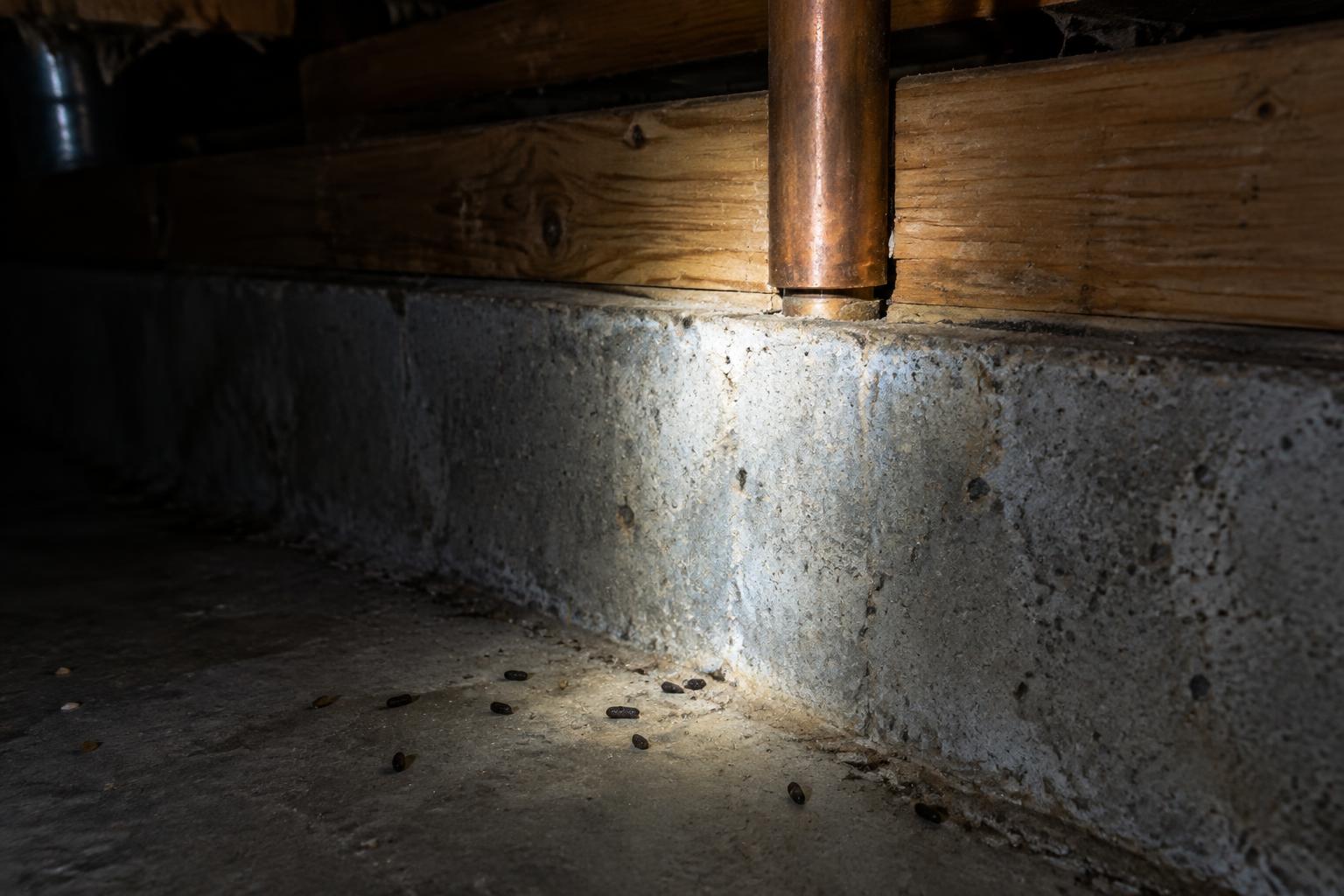
Gap around a pipe in a Long Island basement wall, the kind of quarter-inch opening mice use to get into walls

Quick answer

Mice in your walls are not living in the wall. They are using it as a hallway between a nest (usually insulation in a basement ceiling, a garage wall, or an attic corner) and food in your kitchen. They come out the same gaps they went in, so the fix is snap traps set tight to the wall at those gaps, a sealed entry point once trapping is done, and a follow-up visit about two weeks later. Poison in a wall void is the shortcut to avoid: a mouse that eats it dies inside the wall, and you trade scratching for a smell you cannot reach. On Long Island most jobs are two visits over two to three weeks, covered by our 60 day written guarantee.

Key Takeaways

How do I know the mice are actually in the walls?

If you hear light scratching or a quick scurry inside a wall at night, and it stops when you knock, mice are using that wall as a runway. Mice are active in the dark and use wall voids, the gaps behind cabinets, and the spaces around pipes as protected highways between where they sleep and where they eat.

The nest is almost never in the middle of a wall. It is in soft, hidden material close to the sound: batt insulation in a basement ceiling, the back of a garage wall, under a dishwasher, behind a stove, in a cluttered attic corner. UC IPM, in a fact sheet co-authored by Cornell's New York State IPM Program, notes house mice seldom venture more than about 30 feet from their nest and food. So when a homeowner in Huntington tells me they hear mice in the living room wall every night around 11, I start looking within 30 feet of that wall, and I usually find the nest in the basement ceiling directly below it.

The sounds that tell you it is mice and not something bigger: fast, light scratching rather than heavy thumps, mostly after dark, often in the same spot night after night. Droppings the size of a grain of rice, pointed at the ends, along the baseboard or in the cabinet under the sink confirm it. Rub marks, which are dark greasy smears where fur touches the same edge over and over, show up on sill plates and pipe openings. A musky smell in a closed cabinet is another tell UC IPM lists.

Is it a mouse, a rat, or a squirrel?

Mice are the light, fast scratchers heard at night; rats are heavier and tend to be lower in the house, near water and the foundation; squirrels are daytime animals, mostly early morning and late afternoon, and they are up high, in the attic and soffits. If the noise is at 6 a.m. in the ceiling, think squirrel. If it is 11 p.m. in a kitchen wall, think mouse.

On Long Island we see two mice indoors. The house mouse is gray all over, small, and lives inside year round. The white-footed mouse and its cousin the deer mouse are brown on top with a clean white belly and white feet, and the USDA and University of Nebraska wildlife damage handbook notes they are uncommon in dense suburbs unless there is open space nearby, which is exactly the North Shore, the pine barrens edge in Suffolk, and anywhere backing woods or a park. Those outdoor mice push in when it turns cold, so a wall that was quiet all summer in Oyster Bay or Smithtown can start scratching the first week of November.

The treatment is the same for all of them: find the entry, trap along the runway, seal the gap. The difference is where you look. House mice are usually low, coming in at the sill plate, the garage door corners, and the AC line set. White-footed mice are good climbers and will use a tree branch touching the roof or the gap where the electric service enters the house. If you want the full identification breakdown, our guide to scratching noises in the walls at night covers mice, rats, squirrels, and raccoons side by side.
Why not just put poison in the wall?

Because the mouse that eats it dies in the wall, and now you have a smell you cannot reach for weeks. UC IPM puts it plainly: rodenticide use will often result in house mice dying inside the structure where management is taking place. That is the whole problem. A trap tells you exactly where the mouse is. A poisoned mouse picks its own grave, and it is usually behind drywall or under a tub.

There is a second problem. The products you can buy at the hardware store are limited for good reason. The EPA requires consumer rodent baits to be sold as ready-to-use bait stations, in block or paste form, no loose pellets, and it pulled the second generation anticoagulants off the consumer market entirely. Those stations are built to sit on a floor along a wall. They are not meant to be opened and shaken into a wall void, and doing it puts loose poison where a child, a dog, or a cat can reach it later. In my practice, when we do use bait, it goes in locked tamper resistant stations outside the house, where a mouse that eats it is far more likely to die outdoors.

The third problem is that poison does nothing about the hole. You can kill every mouse in the house this week and have a new family in the wall by Thanksgiving if the quarter inch gap around the gas line is still open. Trapping and sealing solve both. Poison alone solves neither.

How do you get mice out of the walls? The 6 steps

  1. Find every entry point (day 1). We start outside at ground level and go all the way around: the gap between the foundation and the siding, the corners of the garage door, the AC line set, the dryer vent, the hose bib, the gas and electric penetrations, then the roofline for climbers. Inside we pull the kick plate under the sink and the stove, and check where every pipe and wire goes through a floor or wall. The CDC tells homeowners to look for any hole the width of a pencil, 1/4 inch, because a mouse fits through it. On a typical Long Island colonial we find three to six.
  2. Locate the runway and the nest (day 1). Droppings, rub marks, and gnawed insulation point to the path. Mice run along edges, so the trail is almost always the base of a wall, the top of a sill plate, or the edge of a joist. The nest is within about 30 feet.
  3. Set traps where they already run (day 1). Snap traps, trigger end against the wall, so a mouse running the edge crosses the trigger. UC IPM's guidance is traps no more than about 10 feet apart in active areas, and pairs set an inch or two apart where mice tend to jump. Bait is a small smear of peanut butter or whatever food they are already into, and in cold weather a pinch of cotton or dental floss works because the females want nesting material. We place a lot of traps the first night. Mice are curious about new objects and most catches happen in the first two or three nights.
  4. Clear and reset (days 2 to 7). We or you check traps daily, remove catches, and reset. If a trap is licked clean but not sprung, we change the bait or move it an inch. If you are doing this step yourself, wear gloves and bag the mouse, and follow the CDC's cleanup method for droppings: spray them with disinfectant, let them soak, and wipe, never sweep or vacuum dry droppings. Our answer page on cleaning up mouse droppings safely walks through it.
  5. Seal the entries once catches stop (about day 7 to 10). This order matters. Seal first and you trap mice inside with no way out, so they chew a new way, often into a room. Once two or three nights pass with no catches, the gaps get closed. Small holes get coarse steel wool packed in and caulked over so it stays put. Larger holes get metal lath, hardware cloth, cement, or sheet metal, which is the CDC's list. UC IPM is blunt about what does not work: plastic screen, rubber, vinyl, expanding foam, and wood are all chewable. Garage door corners get a new bottom seal. Bobby Bugs does not do construction exclusion work, so for big repairs we show you exactly what to close and how, and a handyman or you do it.
  6. Follow up (about day 14 to 21). We come back, check the traps left in place, confirm the sounds have stopped, and look at every seal. If anything is active, we reset and find the gap we missed. That follow-up visit and anything after it inside the guarantee window is covered.

How long does it take, and what sets the price?

Most Long Island mouse jobs are two visits over two to three weeks: trapping and inspection on the first, sealing confirmation and a check on the second. Sounds in the wall usually stop within the first week once traps are on the runway, because you are catching the few mice that were using that path. A house with a large population in the insulation, or one with a dozen open gaps, runs longer.

What moves the price up or down is not the number of mice. It is access and openings. A ranch in Levittown with a slab, a finished basement, and two pipe penetrations is a smaller job than a 1920s colonial in Port Washington with a fieldstone foundation, a crawl space, a detached garage, and oak trees over the roof. A house where the stove, dishwasher, and washer all have to be pulled to reach the gaps behind them takes more time. A home that needs exterior bait stations for ongoing pressure from a wooded lot adds equipment. We inspect first and quote the whole job in writing before any work, and mouse control carries our 60 day written guarantee, so a mouse that shows up inside that window is our visit, not your bill. You can read the service details on our Long Island mice exterminator page.

Can I just seal the hole now and be done?

No. Not while there are mice inside. Seal the entry with mice still in the walls and you have sealed them in with you. They will chew their way to the nearest food, which is your kitchen, and a sealed mouse that cannot find a way out is the second most common cause of the dead mouse smell, right after poison. Trap until catches stop, then seal.

The other version of this question is whether to seal at all, or whether traps alone are enough. Traps alone work for about a season. Mice are driven indoors every fall, and UC IPM notes mice removed as far as half a mile away can find their way back, so a house that was open last year will be found again. Sealing is the only part of the job that lasts.

What to seal with: coarse steel wool pushed deep and caulked over so it cannot be pulled out, copper mesh in damp spots where steel wool would rust, and metal, cement, or hardware cloth for anything bigger than a thumb. Expanding foam by itself is a mouse's favorite material to chew. Our answer page on where mice get in lists the spots we check on every house. If you want us to do the inspection and hand you the list, our Rodent Entry Point Inspection service does exactly that with a written report.

Mice in the walls of an apartment: landlord or tenant?

In New York the landlord is responsible for keeping a rented home free of rodents in almost every situation. Real Property Law 235-b, the warranty of habitability, says every residential lease carries the landlord's promise that the premises are fit for human habitation and that tenants will not be subjected to conditions dangerous, hazardous or detrimental to their life, health or safety, and the statute makes any lease clause waiving that promise void. Mice in the walls are a textbook habitability condition. The exception written into the statute is a condition caused by the tenant's own misconduct.

The Property Maintenance Code of New York State, Section 309 on pest elimination, fills in the details for Long Island: the owner is responsible for pest elimination before renting a unit and for infestations in a building with two or more units, while the occupant of a single family rental is responsible for keeping the premises pest free, and an occupant who caused the infestation in their own space shares responsibility with the owner. In Queens and the Bronx, Local Law 55 of 2018 adds an annual inspection duty for owners of buildings with three or more units, specifically for mice, cockroaches, rats, and mold, with pest work done using integrated pest management and pesticides applied by a DEC licensed professional. Our guide on landlord pest control responsibility in New York covers the complaint process in each county.

If you are the tenant, report it in writing, with a date, and keep a copy. If you are the landlord or property manager, a mouse complaint in one unit in November is usually the first of several, because the wall voids connect. We treat the building, not the unit, and provide the written per-visit records a managed property needs.

What makes mice in the walls worse, and what mistakes restart the clock?

Bird feeders, pet food left out overnight, a garage door that does not meet the slab, firewood stacked against the house, and tree limbs on the roof all make a mouse problem worse or bring it back. Cold snaps push mice in; UC IPM's numbers on breeding, 5 to 10 litters a year of 5 or 6 pups, with pups breeding at 5 to 6 weeks, mean a pair in October is a colony by January if nothing is done.

The mistakes we see restart the clock every winter: poison in the wall (the smell, and the hole is still open); sealing before trapping (mice chew into living space); peppermint oil, ultrasonic plugs, and dryer sheets instead of traps (UC IPM lists none of them as controls and our answer page on mouse repellents explains why); one trap in the middle of the floor instead of eight along the wall; foam in the gap instead of metal; and calling it done after the sounds stop without ever finding the entry. The one that costs the most is ignoring it. A mouse chewing wire insulation in a wall is a fire risk UC IPM calls out directly, and the hantavirus concern with deer mouse droppings is real enough that the CDC's cleanup rules exist. Mice do not leave on their own in winter. The wall is warm and your kitchen is 30 feet away. They stay until something changes, and the something is traps on the runway and metal in the hole.

Frequently asked questions

How do I get rid of mice in my walls without poison?

Set snap traps tight along the base of the wall where you hear them, trigger end to the wall, no more than about 10 feet apart, baited with a small smear of peanut butter. Check daily. Once two or three nights pass with no catches, seal every gap a pencil fits through with steel wool and caulk, or metal for bigger holes. That is the whole method, and it is what we do.

How long does a dead mouse in the wall smell?

In our experience a couple of weeks or more, depending on how warm the wall is and how much air moves through it. There is no product that removes the smell from a sealed void; it fades as the mouse dries out. This is the reason we trap instead of poison when mice are inside walls.

Why do I hear mice in the walls at night but never see them?

Mice are nocturnal and they travel the protected edges of a house, inside walls, behind cabinets, and along joists, rather than crossing open floor. You hear the runway and never see the mouse because the runway is behind drywall. Droppings under the sink or behind the stove are usually the first thing you actually see.

Will mice in the walls go away on their own?

Not in fall or winter. The wall is warm, the nest is close, and food is within 30 feet. Mice leave when a house gets hot and dry in summer or when the food runs out, and neither happens in a Long Island kitchen in December. Our answer page on whether mice leave on their own covers the exceptions.

Can mice in the walls chew through wires?

Yes. UC IPM notes house mice gnaw electrical wires and appliance cords, and that many fires of unknown origin are believed to be caused by rodents gnawing wires. Chewed wire insulation inside a wall is one of the reasons not to wait a mouse problem out.

How many mice are in my walls if I hear one?

Usually more than one. A female house mouse can have 5 to 10 litters a year, so a single sound in November often means a small family. The number of catches in the first three nights of trapping tells you the real answer; our answer page on seeing one mouse goes deeper.

Should I use glue traps for mice in the walls?

We do not recommend them for a wall problem. A glue trap at a wall opening catches dust and a leg as often as a mouse, and a mouse stuck on glue inside a cabinet is unpleasant for everyone. A correctly placed snap trap kills instantly and tells you exactly where the runway is.

Related reading

Sources: UC IPM Pest Notes: House Mouse (Quinn, UC Cooperative Extension, and Frye, Cornell NYS IPM Program); CDC, How to Seal Up to Prevent Rodents; EPA, Restrictions on Rodenticide Products; Cornell NYS IPM Program, Evict and Exile Mice from Your Home; USDA APHIS and University of Nebraska, Prevention and Control of Wildlife Damage: White-footed and Deer Mice (Timm, 1994); New York Real Property Law 235-b, Warranty of Habitability; Property Maintenance Code of New York State, Section 309, Pest Elimination; NYC HPD, Indoor Allergen Hazards (Local Law 55 of 2018).

Hearing scratching in the walls at night? Call (516) 509-6001 and we'll tell you what it is.

We will find the entry, set the traps on the runway, show you what to seal, and come back to make sure it is quiet. Mouse control on Long Island, in Queens and in the Bronx is covered by our 60 day written guarantee.

Back to all guides

This article is general pest information for Long Island homeowners, not a diagnosis of your specific situation. Pest behavior varies by home, season, and species, and every job is quoted in writing before any work begins. Pesticide applications are performed by licensed New York State applicators in accordance with label requirements.

Call nowText usGet a quote